Did the chestnuts decide to look like hedgehogs to protect themselves?
A very amusing film to explain mimicry to children, this property that certain animal or plant species possess to make themselves similar in appearance to another species or to the surrounding environment.
Cases of mimicry are common among animals but rarer among flora and plants which, unable to move, have developed astonishing properties.
To spread pollen, orchids seduce male pollinating insects by pretending to be females. They also emit a scent identical to the sex pheromones of imitated female insects.
Why not present the curious South American vine, Boquila trifoliolata, capable of copying the appearance of the leaves of different plants on which it clings in order to escape its predators; its genes allow it to imitate more than 10 kinds of leaves!
Make a list of animals capable of imitating their environment? Children are often familiar with the chameleon, capable of harmonizing its color with its environment, to camouflage itself or to communicate its state of mind to its peers. Emerald green, all is well; red or black if it is angry or feels threatened.
If orchids disguise themselves as insects, the praying mantis, Hymenopus coronatus, disguises itself as an orchid to hunt its prey and has a spot on its abdomen that resembles a gnat and reassures insects.
Butterflies disguised as leaves? caterpillars into snakes (Hemeroplanes triptolemus)?
Questions about the film
Understand the story and themes, express your feelings and develop critical thinking.
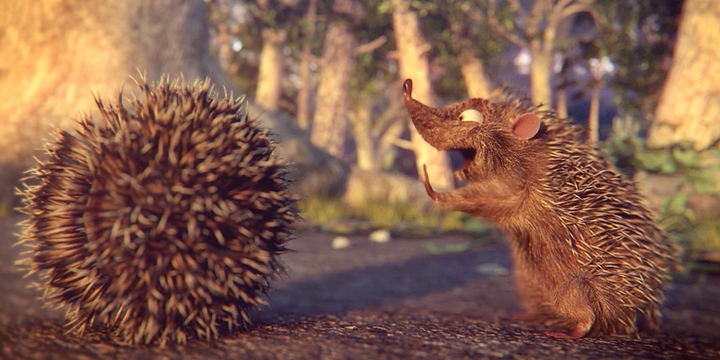
1Who is the character in the film? In what environment does he operate? It's a hedgehog walking in the forest.
2At the start of the film, our little hedgehog has an encounter. Who does he think he is meeting? Who do you think he is actually meeting? He thinks he's found another hedgehog, but it's actually a chestnut.
3Why do you think the hedgehog gets annoyed? He did not understand that it was a chestnut, and, as he is upset that the one he thinks is another hedgehog does not answer him, he tries to provoke her.
4Then why does he start following him at full speed? As he still hasn't understood that it was a chestnut, he thinks that he threw someone else down the slope and so he runs after him to help him.
5When he then finds himself trapped, impaled on the branch, why does he suddenly start to panic? He sees, down below, another hedgehog who will certainly make the same error of judgment.
6Why, at the end of the film, can we see lots of hedgehogs “planted” in the surrounding branches? We then understand that all the hedgehogs in the region are trapped, which gives the film's ending a very comical twist.
Download the film's educational activities as a PDF
Created with the support of the French Ministry of Education and the French National Center for Cinema and Animated Images (CNC).
Watching the film with the family, educational activities with parents at home and with teachers in class.
Our selection of films for children is recommended by teachers and parents to allow young children to watch quality films safely. Teacher reviews and parental control matter. Share your opinion on the films and help us find the best children's films!