
Questioning an animated film
Educational activities, viewing tips and film selection grid
The toolbox, created with the support of the French Ministry of National Education and the French National Center for Cinema and Animated Images (CNC), offers questioning and analysis strategies, generic educational activities and viewing advice.
How can we create the conditions for gradually acquiring a method and greater independence?
Also discover the educational activities by subject, the thematic pathways and the cinema lexicon.
Questioning an animated film
How can we create the conditions for gradually acquiring a method and greater independence, including by making students progressively aware of the existence of invariants in their observations?
While adapting to their age and level, it is the teacher's responsibility to invite students to reflect on the strategies they use to question, analyze and understand, so that they can criticize them, assimilate them, and be able to appropriate them, reuse them and develop them further.
The screening of an animated film should allow students to encounter a work, to question it, to formulate a critical judgment, to express an opinion, an argued point of view, to debate, to compare, to put into perspective, to build links with other works, other arts, other media which have taken up the same object. This is an opportunity for students to acquire knowledge and build skills that they can put to the test at other times.
Anne-Marie Filho, honorary academy inspector, illustrates this point using Risa Kimpara's film, Rain and Fish.
General-purpose educational activities
List of activities and questions common to each film.
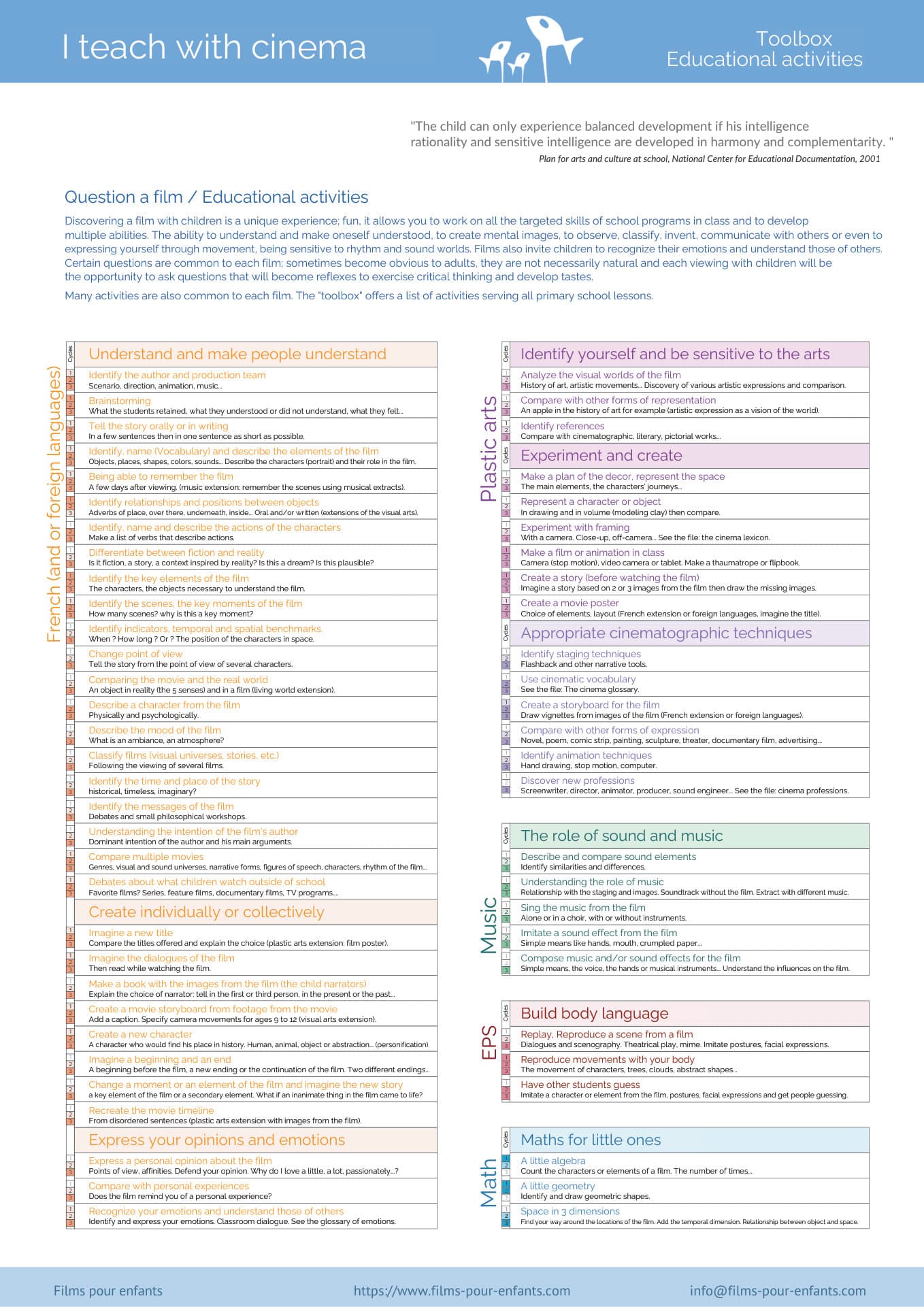
Discovering a film with children is a unique experience; fun, it allows you to work on all the skills targeted by the school curriculum in class and to develop a wide range of abilities. The ability to understand and make oneself understood, to create mental images, to observe, classify, invent, communicate with others or even to express oneself through movement, to be attuned to rhythm and soundscapes.
Films also invite children to recognize their emotions and understand those of others.
Certain questions are common to each film; though they have sometimes become obvious to adults, they are not natural for all that and each viewing with children will be an opportunity to ask questions which will become reflexes for exercising critical thinking and developing tastes. Many activities are also common to each film. The “toolbox” offers a list of activities supporting every subject taught in primary school.
Selection grid and viewing advice
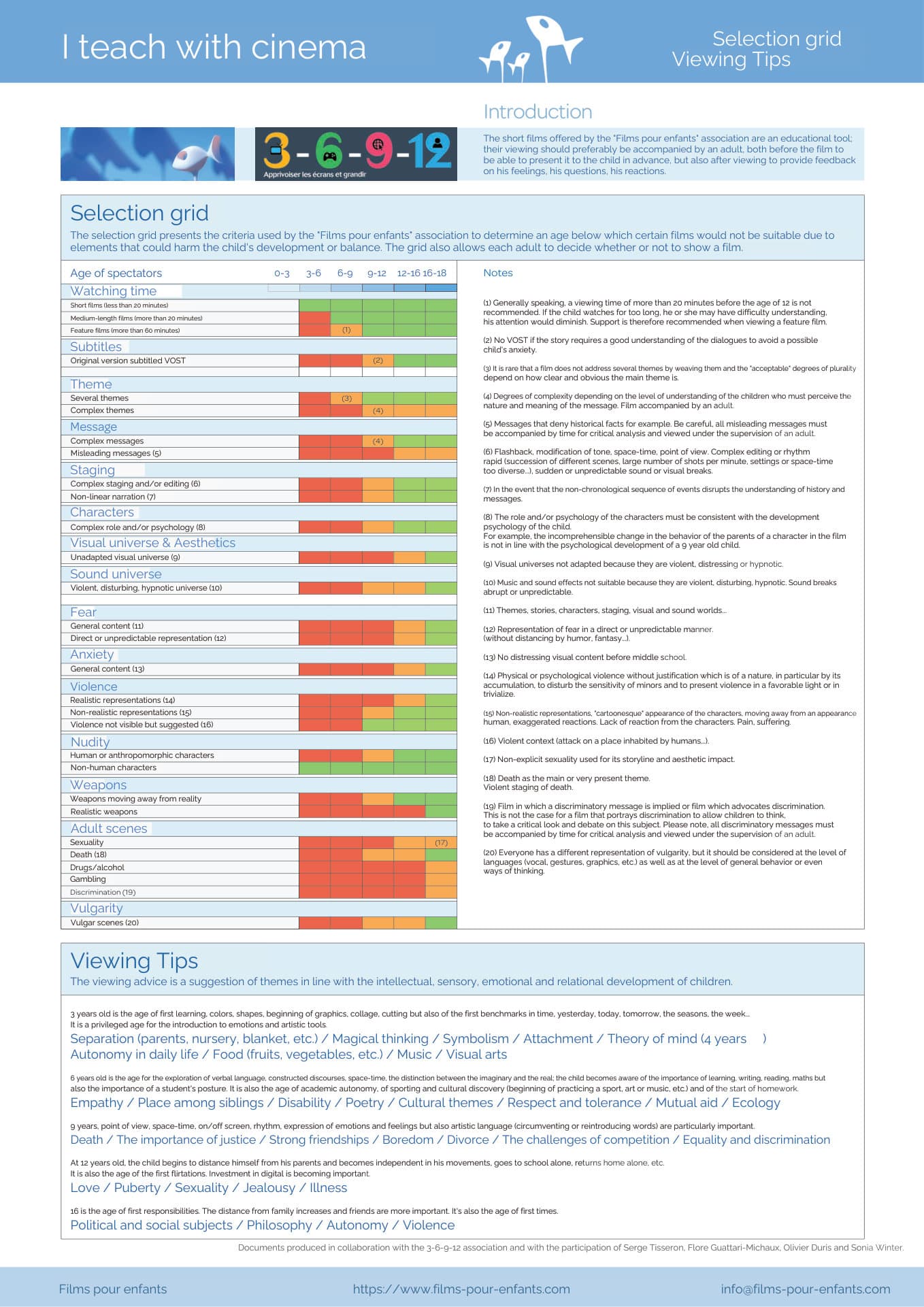
The selection grid, developed in collaboration with the 3-6-9-12 association and Serge Tisseron, ambassador for the Films pour enfants association, presents the criteria used by the Films pour enfants association to determine an age below which certain films would not be suitable due to elements which could harm the child's development or emotional wellbeing.
Viewing time, theme, message, setting, characters, visual & aesthetic universe, sound universe…
The grid also allows each adult to decide whether or not to show a film.
The viewing advice is a suggestion of themes in line with the intellectual, sensory, emotional and relational development of children.
What themes should we discuss with children aged 3, 6, 9, 12 and 16?
Have you used the toolbox for moving-image education? Share your experience, your activities in primary school, the children's reaction.
Have you created tools yourself as part of educational activities dedicated to cinema? Share your tools and ideas with all teachers!