Educational activity based on the short film Alike
Create visual artworks to recount and bear witness. Accept differences.
Understand that shared rules can forbid and compel, but also permit.
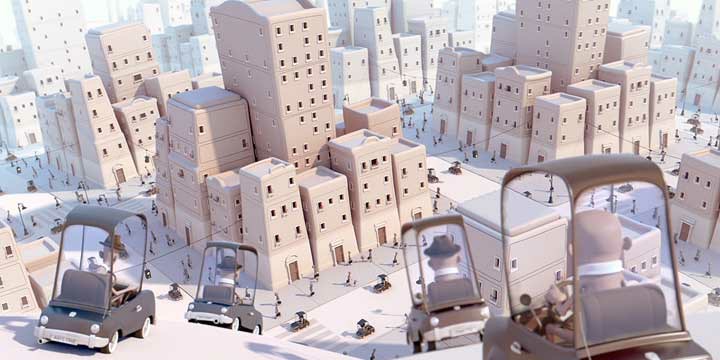
Alike © D. M. Lara & R. C. Mendez
TitleAlike
ThemeCompliance
Genre & keywordsNarrative, uniformity, parental relationship, school, work, social norm
Age (for the film)6-11 years old
Duration08 min 01 s
DirectorD. M. Lara & R. C. Mendez
MusicOscar Araujo
ProductionD. M. Lara & R. C. Mendez (Spain, 2016)
Invent a world where social conventions are reversed.
“Alike” uses several devices to convey the norm-bound world it depicts: visual metaphor, exaggeration, repetition. There is another, widely used in the science fiction genre: logical inversion. What if there was a society where music was the norm and any other form of expression (like writing, arithmetic) was seen as a deviation? What would it look like?
We can put this principle into practice through a game where a group of players creates a set of drawings describing a world where a norm has been inverted and presents them, without oral explanation, to another group of players who did not witness the creation of the drawings and who will have to try to guess which norm has been inverted.
Whether the choice of the standard to be inverted comes from the teacher or from a discussion with the children who invent the inverted world (the group of “designers”), the important thing is the logical exploration, through discussion and drawing, of the consequences of this choice. The teacher could thus write down a list of ideas resulting from the discussion, which will serve as a frame of reference for interpretation.
For the discussion about the interpretation of the drawings with the second group (the “evaluators”), recovering exactly the brief given to the “designers” is less important than the discussion itself. Progress in interpretation is measured against the frame of reference noted in the previous step. The exercise is finished when all the ideas have been expressed by the “evaluators”.
The roles should be reversed, so that each child has the opportunity to practice both invention and interpretation.
Works, images that express “reversed worlds”:
Activity sheet written by: Bruno Pellier