Films pour enfants

Animation workshops: phonotrope

Plastic arts6-11 years old

Educational activity around the short film Come on

Expected end of activities

Implement an artistic project.

Identify the elements of plastic language in a production: colors, shapes, materials, support.

Come on

Come on © Nikodio

TitleCome on

ThemeChase

Genre & keywordsMusical, geometric shapes, square, triangle, round, vinyl record

Age (for film)3-11 years

Duration03 min 35 s

DirectorNikodio

MusicKing Biscuit

ProductionNikodio (France, 2014)

Educational activities

Understand the principle of the phonotrope. Create an animation using the phonotrope technique.

A very nice short film to make children want to animate drawings. Using simple geometric shapes, invite the children to invent, like these three adorable characters, the adventure of 3 new heroes.

Before experimenting with this animation technique with children, discover the very informative video of an event by Nikodio producing a film on disc live: The phonotrope in concert... More information on the Nikodio website...

This exciting activity for children requires special equipment and remains a little difficult to set up; the teacher will test this technique himself before offering it in class.

1- Material for this activity

  • A vinyl record player.
  • A vinyl record.
  • Sheets of paper.
  • Colored pencils or coloring pens.
  • A digital camera and a tripod.
  • A video projector. This animation technique does not work without a camera; The optical illusion is the result of the matching between the shutter speed of the camera and the rotation speed of the disk. Another technique would be to create the visual interruptions using the flashes of a strobe.

2- Preparation of the support

  • Cut a sheet of paper into a circle (same diameter as the vinyl record).
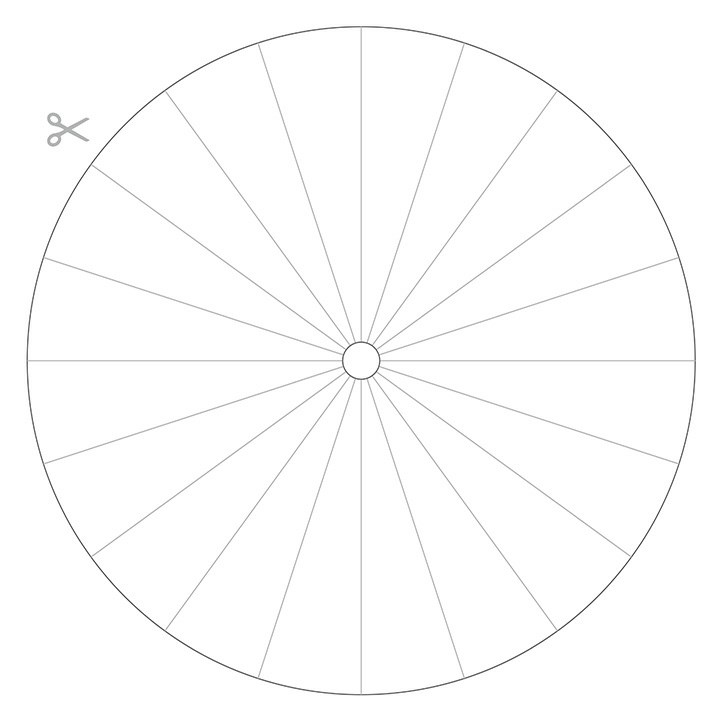
  • Separate the paper disk into 20 parts. This preparation can be done with the children. To do this, before sticking the sheet of paper on the vinyl record, separate the paper record into 4 quarters by tracing the first two diameters. Each quarter must then be separated into 5 parts. You can also download and print a 20-part disc separation template.
  • Glue the sheet of paper to the vinyl record.

3- Drawing and animation

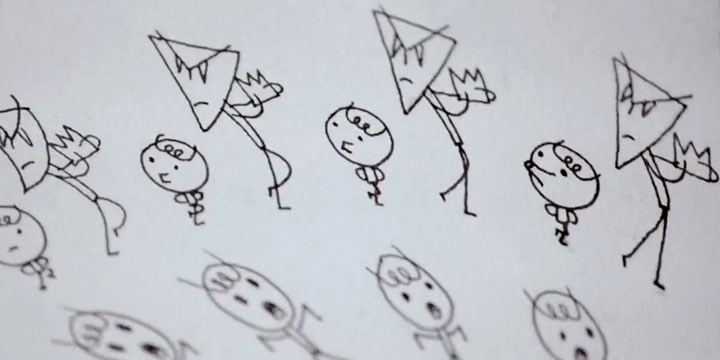
  • Imagine a movement that can be repeated endlessly (a bouncing ball, clapping hands, etc.). For a first animation, choose simple geometric shapes like a triangle, a square... Discover examples of children's creations...
  • Draw each step in order on each of the 20 parts of the paper disk.

4- Viewing

  • Position the digital camera vertically above the disc.
  • Spin the record on the record player and turn on the camera. The camera settings depending on the disk rotation speed will have been tested before.
  • Watch the animation through the camera eye connected to the video projector.
  • Compare the projected animation with the animation on the disc itself to understand that this illusion does not work when looking directly at the disc but only thanks to the adequacy

between camera settings and disk rotation speed.

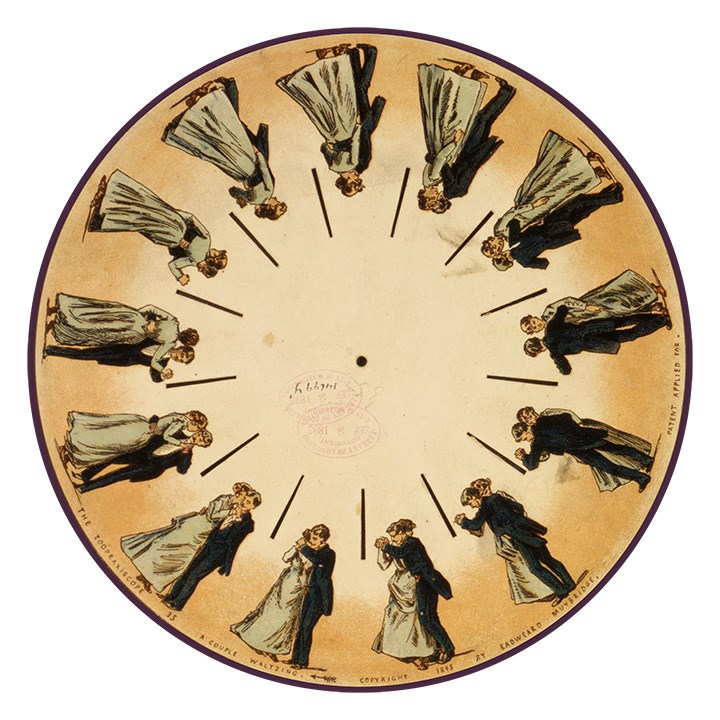
Phonotropic animation like that of the short film remains difficult to implement. Another technique, simpler but just as exciting, can be adopted: the phenakistiscope. The phénakistiscope (1832) requires neither a record player nor a camera, simply a cardboard disc.

Print the materials for this activity...

Other extensions

  • The ancestor of the cartoon on disk is the zoetrope (1834), an animation technique at the origin of the invention of cinema, the principle of which was to draw a sequence of drawings representing a cyclical movement inside a cylinder pierced with slots. Looking at the rotating cylinder from the outside, the slits allow the drawings to be seen and the solid parts of the cylinder act as a shutter, causing the retinal persistence to be erased and creating the visual illusion of movement.

Activity sheet written by: Christophe Defaye
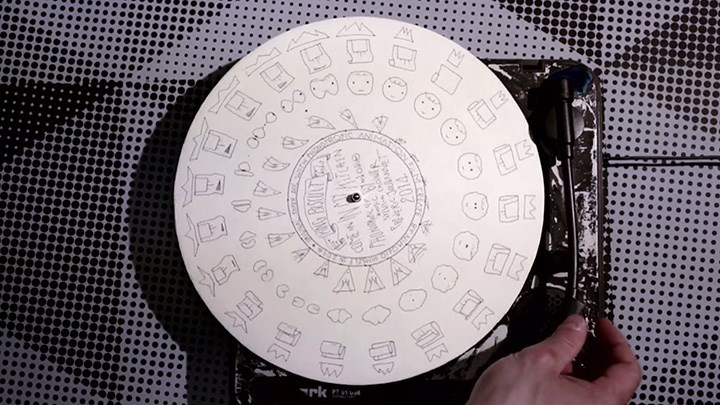
Come on © Nikodio
Come on © Nikodio
Model for phonotrope. CC0