Educational activity based on the short film Cooped
Share your emotions, express yourself in front of others, argue.
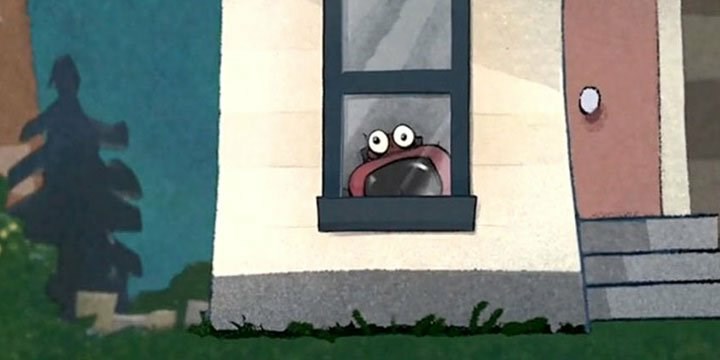
Cooped © Ten Pound Toons
TitleCooped
ThemeAbandonment, Animals
Genre & keywordsComic, abandonment, animals, dog
Age (for the film)6-11 years old
Duration09 min 00 s
DirectorMike A. Smith
MusicJ. M. Askew & C. Gray
ProductionTen Pound Toons (United States, 2014)
Make hypotheses, express yourself and argue.
« Oral discussion about the short film, making predictions about the ending », oral and written activities on the animal condition.
This short film tells the story of a poor dog locked up by his owner and who thirsts for freedom. This man is not fit to take care of his animal, or himself for that matter! We feel that the frustration is getting stronger and stronger, « the dog eventually loses control » and he breaks everything in the house! The ending is rather comical and happy for « the animal that can finally enjoy a breath of fresh air »! This film will be an opportunity to talk about the animal condition in class. We can note that « the haunting music nicely captures the man's nonchalance and the animal's boredom ».
For the first viewing, stop at 7’44. Ask the children to tell the story, to say what they understood. To do this, you can use the “question the film” sheet. Then ask them to hypothesize about the end of the story: What do you think will happen? How will the story end? This work can be done orally or in writing. Have a group discussion then watch the end of the film. Not only will the dog get out of the house, but he will explore the world. We can follow his journey in the end credits. You can pause the image at each destination and « have the children guess the different countries it has travelled through ». As for the owner, locked up in turn, he finds himself in the situation that he himself put his animal through. What will become of him? « We can make predictions again. »
Then, watch the film again and « have the children take notes for more in-depth work »... On the second viewing, focus on the animal's emotions. « His longing for freedom comes across clearly on screen », particularly at 1 min 57 s, « we watch the landscapes roll past in front of him ». The tension rises more and more; « physically, his appearance changes: his eyes bulge and become bloodshot ». He becomes more and more agitated and ends up breaking everything in the house, « without realising this is what will set him free » (broken door handle).
On the third viewing, focus on the man: is he capable of taking care of the animal? Obviously not, since « he can't even look after himself properly »! Ask the children to look for examples in the film. From the beginning, we see him serving coffee in the dog's bowl; he thinks about blowing on his cup of coffee to cool it but it’s dog food he has in his hand!
Then start a discussion on the animal condition. Do animals feel emotions? « Do they feel pain? » Is it okay to lock a dog in the house? Then we can expand and talk about abandonments at the beginning of summer, hunting, bullfighting, cockfights, factory farming, animals in circuses, force-feeding of geese... « Give the children a range of resources: films, non-fiction texts, novels, reports... » The children will be able to research a theme and « give a presentation to the class ». And to finish and give a great example of human/animal complicity, discover the trailer for the film “Hatchi” inspired by a true story.
Activity sheet written by: Valérie du blog Val 10. Discover the Val 10 blog...