Educational activity based on the short film Giant sun
Being able to reinvest scientific notions in plastic production.
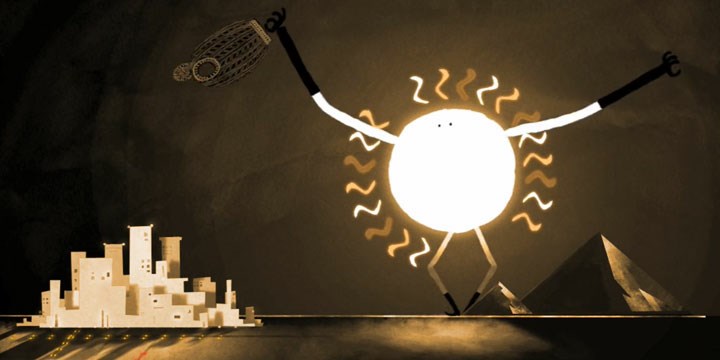
Giant sun © Y. Benedi & C.Desrumaux
TitleGiant sun
ThemeSun
Genre & keywordsComic, ray of sunshine, city, traffic
Age (for the film)3-11 years
Duration01 min 12 s
DirectorY. Benedi & C.Desrumaux
ProductionY. Benedi & C.Desrumaux (France, 2010)
Describe the movements of the earth: rotation on itself and day/night alternation.
This video is short but it is nevertheless very rich. It is in particular a dream opportunity to work on the alternation of day/night, on shadows, the distinction between light and shadow and the associated colors in visual art.
The video could be a start for working on this project combining science and visual arts. After working with the children on the main meaning (the sun wants to recover its escaped ray, and it has great difficulty achieving this), we will be able to do more in-depth deciphering work to bring out certain elements which will be useful later.
Ask the students what happens when the sun shines too much: the city wakes up and comes alive. Which hinders him from catching his ray. He will therefore have to use stratagems to achieve his ends. Collect students’ representations of day/night alternation. Why does the sun “rise” and “set”? After this collection start the sequence.
To illustrate this lesson, we can offer students fundamentals videos on this subject. Older children can be asked to build a model; a file is available on the lamap website.
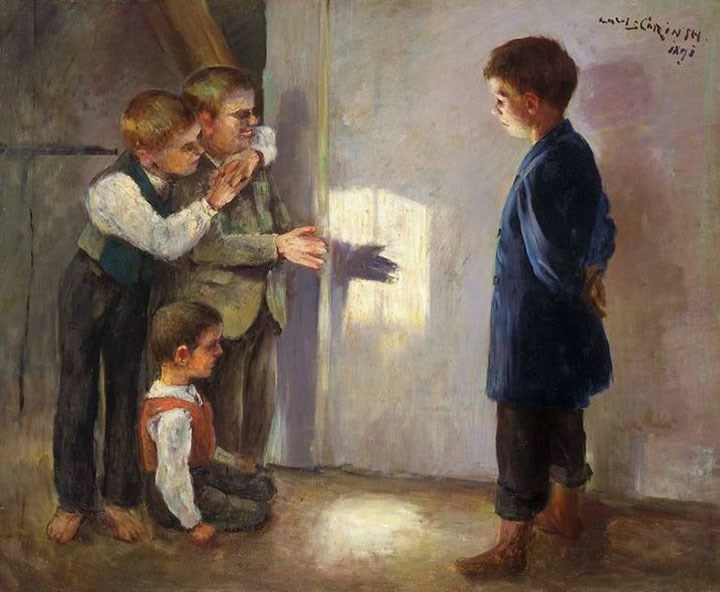
As part of this work the notion of shadow will certainly have been mentioned. We can return to the video and ask the students to show the shadows, those of buildings, pyramids. Why are the shadows on this side? Because they are opposite the light source. Then put it into practice and ask the students, one sunny day, to go into the schoolyard and draw their shadows with chalk on the ground. Identify where the sunlight comes from and the direction of the shadows. Then do the same work in class with an unnatural light source this time (a lamp) and draw the shadows of various objects found in the class.
After all these manipulation phases we will be able to move on to drawing. Ask the students to draw a character or an object, a natural light source or not, then its shadow, this time without supports. Ask yourself the question of colors, which ones to choose for light and shadows? This work will allow you to see if the students have understood correctly.
Activity sheet written by: Valérie du blog Val 10. Discover the Val 10 blog...