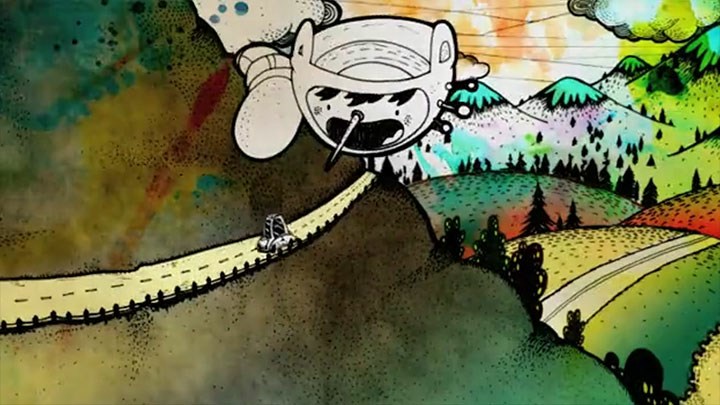
Educational activity based on the short film Head
Understand a literary text and interpret it.
Produce varied writing by appropriating the different dimensions of the writing activity.
Rewrite based on new instructions or evolve your text.
Literary culture: Creation stories, poetic creation.
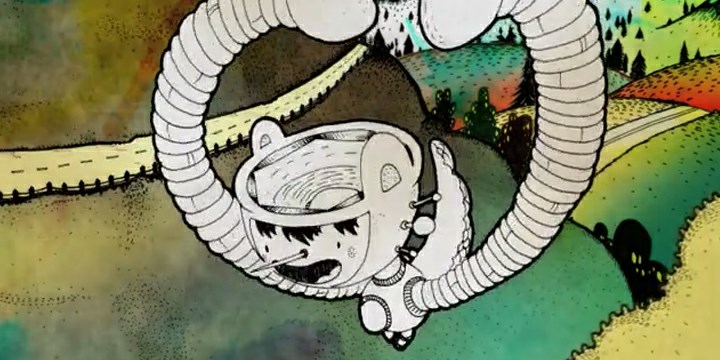
Head © Parquerama Studios
TitleHead
ThemeRobot
Genre & keywordsSurreal, car, bus, road, plane
Age (for the film)9-11 years old
Duration02 min 25 s
DirectorM. Vigliano & D. Zaballa
MusicAriel Gandoflo
ProductionParquerama Studios (Argentina, 2010)
Write a text based on repetition.
Head is a perfect example of a visual object exploiting the repertoire of circularity. It is not difficult to imagine similar examples for the art of dance (from childish dance to whirling dervishes), even less so for music (from refrains to repetitive music). On the other hand, what would this correspond to for the text?
We traditionally learn at school to ban repetitions in written expression, both because they are the hallmarks of oral language and in the idea that a successful style must use all the lexical and grammatical variations of the French language. However, in poetry or the novel, it widely uses the processes of repetition and loop, either for musical purposes or rhetorically, to support an idea. (There is in fact a figure of speech which precisely codifies this usage: epanadiplosis.) Working with children on circularity processes allows them to measure the latitudes in the use of language, to see its rules and limits as expressive possibilities rather than as constraints.
We propose to work from the generalized use of loops in the poetry of Christophe Tarkos (born in 1963, died in 2004), in particular in Caisses (1998), which acts as an inventory with regard to the process. If it is complicated to contextualize his work for 9-11 year olds, we can simply note that his poetry on the one hand develops in improvisation and on the other hand is nourished (in addition to the tradition of the 20th century avant-garde) from everyday language: banal conversations, media speeches, etc. – which brings it closer to more popular spoken poetry movements, such as slam. The goal of the activity will be to distinguish several types of loop effects in these poems and to manipulate them to produce a text based on an initial idea/expression provided by the teacher.
We can start by putting the children directly in front of a poem, by having them read it aloud for example (but each one follows with the text in front of them), and by discussing their first impressions. “There is milk everywhere” (p. 9), “On a cushion on a sofa” (p. 15), “I make greenery” (p. 17) or “Real life is having a car” (p. 29) are interesting starting points. It is a question of highlighting this impression that the poem “goes in circles”, that it revolves around a subject, an initial formula, which it seeks to exhaust. Then present the work as writing “in the manner of” Christophe Tarkos in this poem.
For the choice of theme, you should propose a very common everyday object or situation, as in the poem “There is milk everywhere” (p.9) – for example: “television”, “bicycle”, “green vegetables”, “handbag”… We can also propose a ready-made formula, an image that is flat from being used, as in the poem “We can also live in a village” (p. 22) – for example: “to succeed you have to work”, “Friends are important”, “Every day He’s bigger.”
From there, several avenues and methods are possible:
restrict diversity) to take advantage of chance and the diversity of linguistic contexts. Hence the interest in choosing a very common starting word. The text is then arranged by the child from these sentences, putting them in the order they want and possibly interspersing short sentences or parts of sentences to create connections. See for example “The Handsome Man” (p. 61), or “On a Cushion on a Sofa” (p. 13). We can present the work as a way of describing all facets of the object. We can also draw inspiration from definitions in language dictionaries and their series of citations.
A “collective” variant of this method consists of asking each child in the class to find a sentence, then to jointly develop the text by arranging these different sentences.
In all cases, once the poems are written, they are presented to the class or displayed. They give rise to a discussion on the chosen process and the expressive effects produced, compared or not to the models used. This discussion can be followed by a new writing session, to follow a different path or improve the poems.
Activity sheet written by: Bruno Pellier