Educational activity based on the short film Leitmotif
Recognize basic emotions, know the vocabulary of emotions.
Carry out an art project.
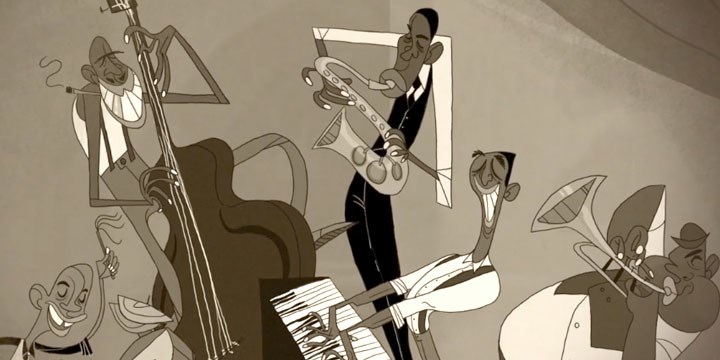
Leitmotif © The Animation Workshop
TitleLeitmotif
ThemeAnimals, Memory, Music
Genre & keywordsComedy, Jazz, nostalgia, musical instrument
Age (for the film)6-11 years old
Duration07 min 06 s
DirectorJ. Nørgaard & M. Thorhauge & M. Jørgensen & M. I. Holmriis
MusicJ. Baumgartner & T. R. Christensen
ProductionThe Animation Workshop (Denmark, 2009)
Identify and express your emotions and feelings, learning to manage them. Be capable of empathy.
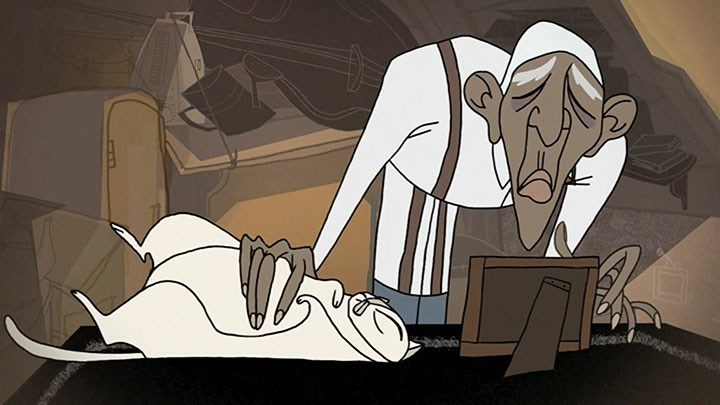
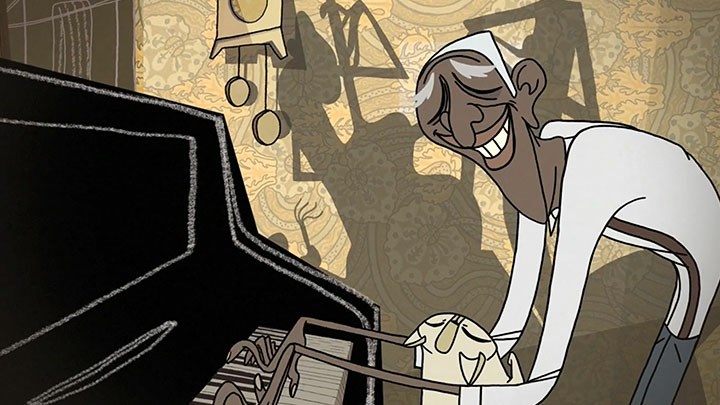
After a first viewing of the video, which will have let you focus on what it means, ask the students to watch this video again with a task to complete: ask them to note the different emotions the character goes through. At the beginning of the film, he is playing the piano, alone in his room, he is sad, with the corners of his mouth turned down. We understand that he feels nostalgia when he looks at the photograph of his jazz group in which he is beaming / smiling broadly. This contrasts with the emotions he is feeling at that moment. The character goes through various emotions, he is nostalgic, sad, then little by little he experiences joy again which he shares with his cat. The corners of his mouth are turned up and you can see his teeth!
After this decoding work, we can broaden the discussion by asking students to name the emotions they know and introducing the ones they don't: sadness, joy but also anger, shame, surprise, disappointment, satisfaction, disgust, surprise. In order to explain and agree on the meaning of all these emotions, we can use the dictionary, give each group of students a list of words to look up in the dictionary. Plan a whole-class discussion to share what they found. Create a glossary based on this work which will serve as a basis for the card game.
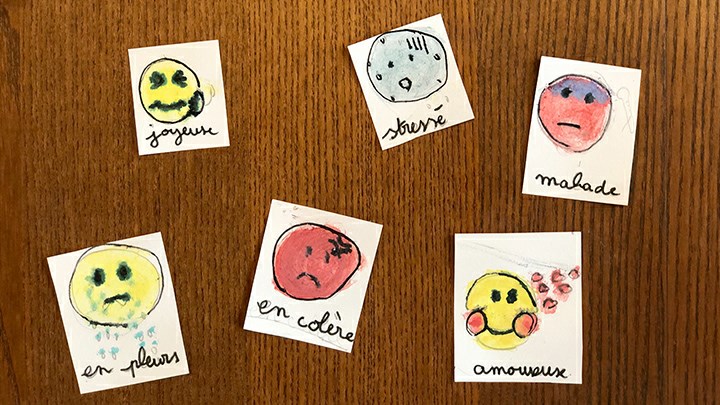
We can then work on expressions linked to emotions: (FR) « vert de rage » (green with rage), « rouge de honte » (red with shame), « une peur bleue » (a “blue” fright)... This naturally leads on to visual arts activities about the colour of emotions, how to express emotions through drawing (using smileys for example). This way, students will have what they need to illustrate the emotions listed. All this can be brought together in the form of posters (the emotion, its definition, images and drawings to illustrate) to keep track. From this vocabulary and visual art work, we can create a deck of cards: a card - an emotion - a drawing, or “word” cards and “picture” cards that have to be matched.
Before creating the game, and to reuse the vocabulary, we can play a speaking game with the students: Give them specific situations (a classmate stops speaking to you) and ask them what emotion they would feel if they were in this situation. Ask them to complete: When I feel... (sad, angry), I need...
And why not make another poster with the students' ideas.
We can then move on to building the game. This can then serve as a basis for other activities. We can imagine, for example, a ritual during which each student will choose a card according to their mood of the day. This can be done first thing in the morning, to say what frame of mind you arrive at school in, or at the end of the afternoon to take stock of the school day. The point is to help everyone be better understood and understand others. Older children can present the game to classes of 6-9 year olds or children aged 3 to 6 so that they can use it.
Other extensions:
think about the characters, complete the character bubbles in the illustrations).
Activity sheet written by: Valérie du blog Val 10. Discover the Val 10 blog...