Educational activity based on the short film Les Musiciens de Brême
6-9 years: Write texts by beginning to adopt a writing process: finding and organizing ideas, developing sentences that flow together coherently, writing these sentences.
9-11 years: Use writing to think and learn. Carry out a writing process: draw on a frame of reference, find and organise ideas, and construct sentences.
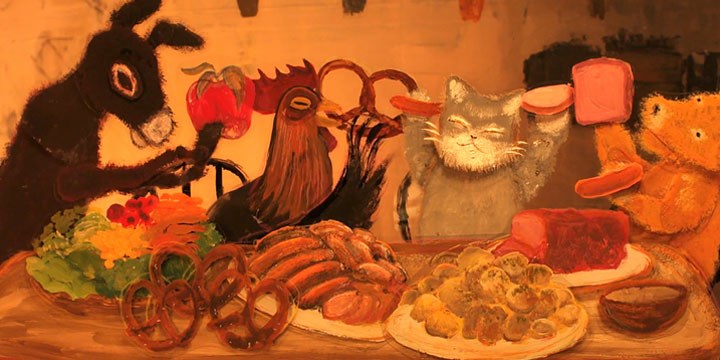
Les Musiciens de Brême © Masataka Hiroyasu / Tokyo University of the Arts
TitleLes Musiciens de Brême
ThemeFriendship, Animals, Traditional tale
Genre & keywordsNarrative, folk tale, animated painting, friendship, animals, thief.
Age (for the film)6-11 years old
Duration03 min 38 s
DirectorMasataka Hiroyasu
MusicYumeko Miyamoto
ProductionTokyo University of the Arts (Japan, 2102)
Read and write about the musicians of Bremen.
The short film presents an adaptation of Jacob and Wilhelm Grimm's tale “The Musicians of Bremen”. With this adapted version, we can ask the students to write the corresponding story. Then, we can introduce them to the tale and its world, then compare it with the students' summarised version.
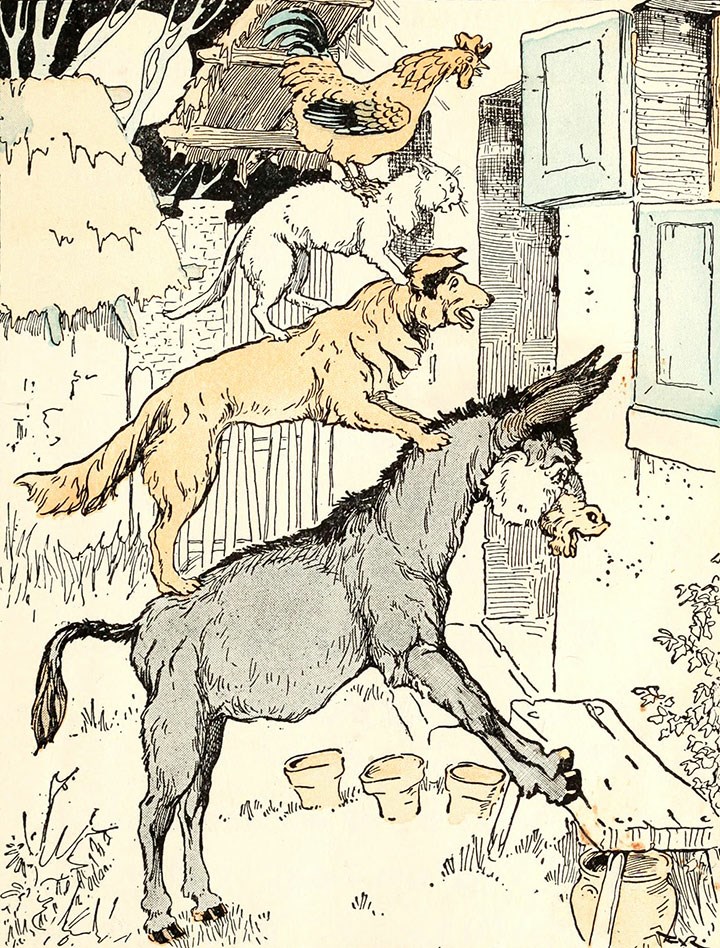
Session 1 Firstly, students will watch the entire video and share their thoughts freely about it. The original tale is a cumulative tale. This means that it is a short text that presents a chain of characters and events that repeat until the final outcome. The animals are personified and presented in an anthropomorphic form while keeping their animal characteristics. On the second viewing, the students will be asked to focus on the characters who appear and list them: the peasant and his donkey, the dog, the cat, the rooster, the bandits.
After having drawn up the list of characters, we will look at the links between them and what happens to them. Depending on the level of the students, we will retell the tale orally, with the adult scribing (dictée à l'adulte) to move it into writing or we will ask them to write the summary of the actions themselves in their own words.
The summary could take the following narrative form: “A master gets rid of his donkey. The donkey is sad and dreams of music. They meet a dog, a cat and a rooster. These animals have the same dream as him and they leave together. When night falls, they seek shelter. There are bandits in this shelter. The animals scare them off with their cries and settle in after eating their fill. The bandits return but the animals scare them away again. They move into the house.” - In musical education: learning to sing “Hello world”.
Session 2 Resume writing the summary, before discovering the original tale, to improve and enrich it with the following instruction: “Add dialogue between the characters.” Students can also perform them aloud. Discovery of original story The Bremen Musicians through reading by the teacher with reconstruction of the text in puzzle reading as proposed by the But what does the mistress do? blog
Extensions, cross-curricular links and resources
Activity sheet written by: Aurélie Moriceau du blog Maikresse72. Discover the Maikresse72 blog...