Educational activity based on the short film Mirage
Carry out, with the teacher's help, a few steps of an inquiry-based approach.
Locate a place on a map or globe.
Recognize, name, describe, reproduce, construct some geometric figures.
Recognise and use the concepts of alignment, equal lengths, midpoint and symmetry.
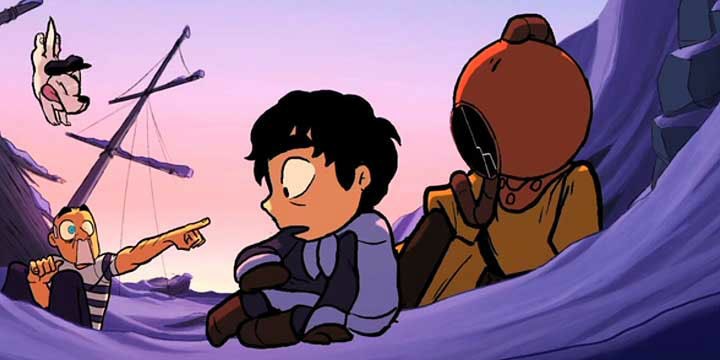
Mirage © School of Visual Arts
TitleMirage
ThemeMirage
Genre & keywordsNarrative, mirage, magical, friendship, animals, fish, miraculous fishing, dream
Age (for the film)3-11 years
Duration09 min 19 s
DirectorIker & Dana
MusicA. Reumeurs & J. Kleijnen
ProductionSchool of Visual Arts (United States, 2013)
Explore the idea of antipodes on a globe.
If we look more closely, the idea of the antipode in Mirage is only symbolic. The two places described are especially opposite in geoclimatic terms (one is arctic and desert, the other is tropical and aquatic). In this activity we explore this notion in a slightly more scientific way. What is the antipode in the geometric sense? What is the geographic antipode of the film’s location? For the hands-on work, we will use the parts of a build-your-own light-up globe, putting together only the two hemispheres.
1. approaches to the antipode
We can start from the Latin etymology of the word: anti- “opposite” and -pode “the feet”. Originally the word designates an individual, who, located on the other side of the Earth, so their feet point in exactly the opposite direction to ours (see the scene in the film where the boy discovers the diver on the other side of the ice). The term later came to mean the opposite point on the terrestrial globe, which is the furthest away. But what is the opposite of a point on a sphere? How to find it?
We can start by thinking about a circle and first show that, if we travel around the circumference from a given point, the furthest point is one diameter away. Using the 3D sphere, by wrapping a piece of string around it, we look for the largest possible circle passing through that point. You can make marks on the wire to keep it as a reference. Children already know this largest circle, it is called the Equator. It allows us to divide the globe into two equal halves in our minds, as a diameter divides the circle.
2. manipulations on the terrestrial globe
Now, if we pass this circle (the marked wire) through the north pole, we can define the south pole, which is the antipode of the north pole. If we return to the terrestrial globe to be assembled, we can notice that the plastic arm holding the two hemispheres together attaches at one end to the north pole, on the other to the south pole. Since the north pole and south pole are antipodes, this means that this plastic arm is exactly the length of the path from one point to its antipode. We can use it as a “ruler” to find the antipode of any point on the globe (provided we ensure that we are tangent to the sphere, that is to say that the path follows the surface of the globe).
After this demonstration, we can use our tool to find several antipodal points. The region described in the film, which is one of the areas where the Inuit live, can be located on the globe and we will verify that its antipode is somewhere on the edge of the Southern Ocean or in Antarctica.
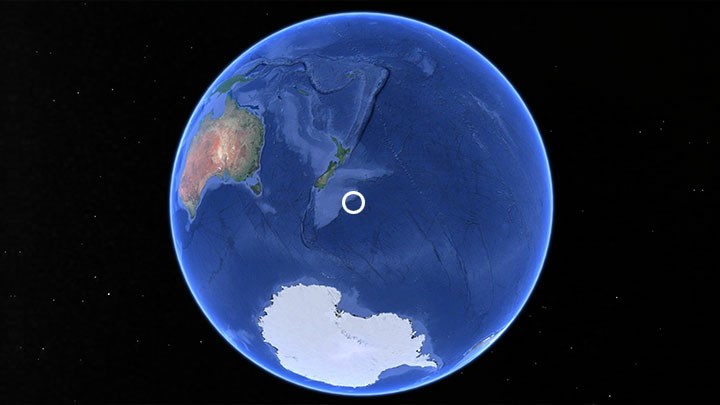
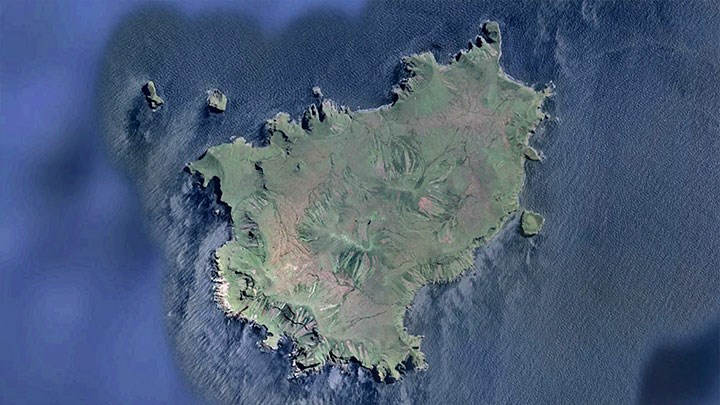
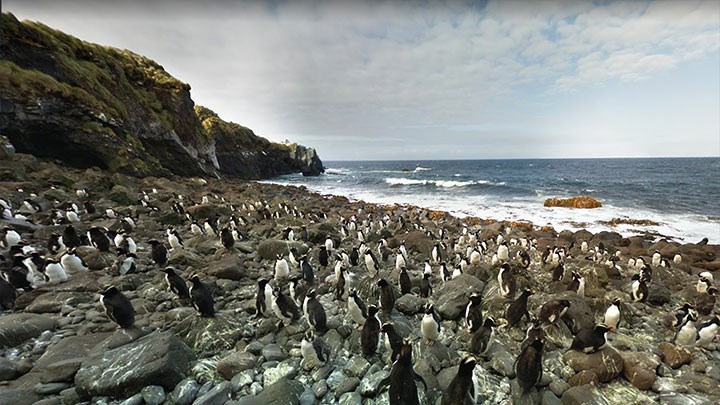
In France, we find that its antipode falls off the coast of New Zealand. The Antipodes archipelago in New Zealand takes its name from the fact that it was thought to be the land closest to the antipode of London (it has since been calculated to be the antipode of a point located off the coast of Cherbourg).
And that “Antipodes Islands” in New Zealand are the polar opposite of “Gatteville-le-phare” in Brittany. A distance of approximately 20,000 km separates them.
Activity sheet written by: Bruno Pellier