Educational activity based on the short film Shave it
Know the characteristics of the living world, its interactions, its diversity.
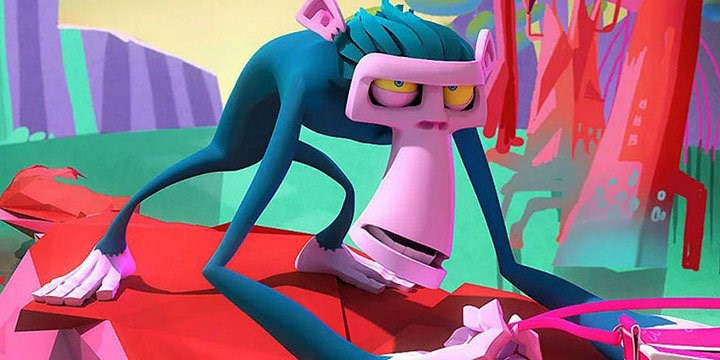
Shave it © 3Dar
TitleShave it
ThemeAnimals, Ecology, Human activities
Genre & keywordsNarrative, forest, deforestation, monkey, razor, revolt
Age (for the film)9-11 years old
Duration04 min 11 s
DirectorJ.Tereso & F. Maldonado
MusicJ.Begault & C. Marchesseau
Production3Dar (Argentina, 2012)
Think about the evolution of species.
Our relationship with nature and particularly with animals is constantly evolving. From the hunting of large mammals to mass breeding through domestication, our links with animals which oscillate between domination, affection or even fear are called into question by recent scientific discoveries.
On January 28, 2015, the National Assembly voted for the final reading of the following bill:
The animal is now recognized as a “living being endowed with sensitivity” and
is no longer considered movable property.
This radical change clearly shows us to what extent our relationship with animals has changed.
Organize a debate with students around our relationship to the animal world. Ask questions about man's interest in animals, shepherd dogs, dairy or meat cattle, pets, etc.). What is the difference between animals and men? Think about how the perception of this difference has evolved over time.
Listen to Jean Claude Ameisen's show, On Darwin's Shoulders: Concern for others... In this show, Jean Claude Ameisen emphasizes the fact that recent, ever more in-depth studies highlight the fact that the feeling of empathy exists in animals, particularly in monkeys, a concept that was still unimaginable a few years ago.
Researchers also observed a tribe of white-faced capuchins, another species of monkey, on an island in Panama's Coiba National Park. They use stones as hammers or anvils to open fruit stones, for example. Even if this does not correspond to the Stone Age which for man corresponded to the fact of shaping and cutting stone for specific purposes, it still raises questions about the future evolution of primates.
Activity sheet written by: Olivier Defaye