Educational activity based on the short film The best toy
Understand the function and functioning of manufactured objects.
Use drawing in all its diversity as a means of expression.
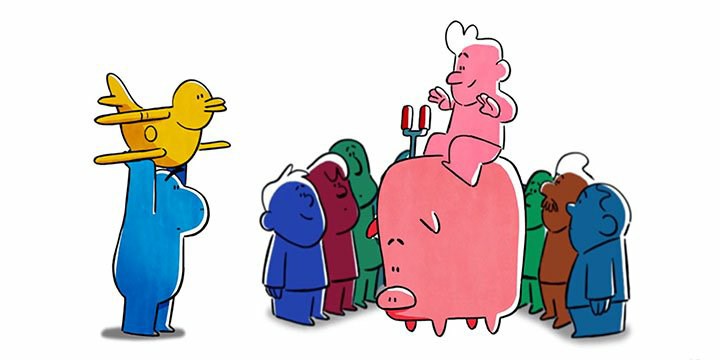
The best toy © Gabriel Lin
TitleThe best toy
ThemeFriendship, Appearance
Genre & keywordsComedy, exclusion, toy, friends, self-confidence
Age (for the film)3-9 years
Duration02 min 46 s
DirectorGabriel Lin
MusicPepper Rivera
ProductionCalarts (United States, 2014)
Describe and compare the life cycle of two toys
In the film, the relationship with the toy is described solely in the mode of immediacy: a toy appears and it arouses an immediate desire, each coming to dethrone the previous one. The main character implements a more sustainable approach for a while, by adapting his existing toy and adding functions to it. But he ultimately fails. If he learns anything from his failure, it is the value of his relationship with his original toy. This conclusion risks missing a question about sustainability, which is nevertheless implied by the description of the race for novelty that the character undergoes. Considered as products of our company, not all toys are equal in terms of durability.
To think about this idea, we can work on the “life cycle” of a toy, which can be simply defined in 4 phases: its manufacturing process, its distribution methods, its duration of use, its future as an object (transmission, waste, recycling).
This activity can give rise to a supported project, addressing the main concepts of Life Cycle Analysis (carbon footprint, socio-responsible production, etc.). It can also be carried out in a more limited way to raise children's awareness of a societal level of reflection about an emotionally central object in their home. We can use simple indicators (for example an evaluation of the number of trips necessary, the duration of the phase), approach the notion of cycle, etc.
Concretely, the work consists of carrying out the necessary research together and presenting the results in the form of diagrams, which will be the occasion for graphic/iconographic creation work.
The procedure could consist of working on a first toy where the information is quite easy to obtain (e.g. Lego, Playmobil) and in a fairly directed manner initially to understand the 4 phases, then redoing the work on a second toy that is quite different (e.g. Hand spinner, Beyblade tops, etc.).
Activity sheet written by: Bruno Pellier