Educational activity based on the short film The Visitors
Practice, with the help of teachers, some moments of an investigation process: questioning, observation, experience, description, reasoning, conclusion.
Know the characteristics of the living world, its interactions, its diversity.
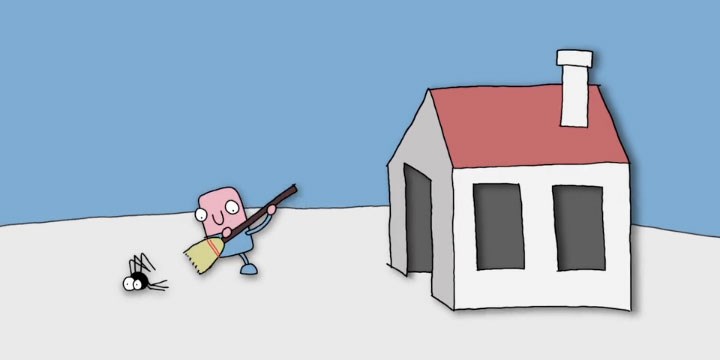
The Visitors © Philip Watts
TitleThe Visitors
ThemeAnimals, Intruders
Genre & keywordsComic, spider, house, broom, intruder
Age (for the film)3-11 years
Duration01 min 00 s
DirectorPhilip Watts
ProductionPhilip Watts (Australia, 2014)
Study the animals that live unnoticed in our homes.
The visitors is clearly based on the idea that spiders are strangers in the house (see the title) and that men must stop their proliferation (see the light references to the “monster film” or “zombie film” genres). But is this habit of thinking right? Is there not a whole range of wildlife in our homes, almost unnoticed, that has adapted to it and lives alongside us?
Such species are called “synanthropes”. They are not domesticated but live in an interactive relationship with humans or their domestic animals. They benefit from its food (mice, flies), its waste (cockroaches, mites) or just the shape of the house (spiders, swallows). Due to this discreet cohabitation and cultural patterns stigmatizing certain parts of the animal kingdom, they are often considered harmful. But if we want to consider the house as an ecosystem in its own right, they can have an interesting role for humans (mosquito predation on spiders, for example).
We therefore propose to aim for two objectives: on the one hand to observe this fauna to extend the concept of biodiversity to the least visible species, on the other hand to get an idea of the complexity of the relationships between species within an ecosystem.
The activity can take place in two stages: observation and representation.
At the end of these observations, the results are pooled to note similarities and diversity. This is an opportunity to discuss, under the guidance of the teacher, the notions of genus, species, habitat, diet, and all the elements that can introduce the idea of scientific description. It is also an opportunity to take stock of the relationships between species and make hypotheses about the synantropic relationship.
We can also extend the reflection by imagining a house project with “positive biodiversity” (see wikipedia page).
- On the concept of “Commensalism of Man”, two pages from the Zoom nature site: What does being a commensal of Man mean? and Commensalism, interaction +/0.
- Two articles for the general public on the subject on the Futura Sciences website: House spiders: why should we not kill them?, Biodiversity: the little-known animals in our homes.
Activity sheet written by: Bruno Pellier