Educational activity based on the short film The Visitors
Produce texts, beginning to adopt a structured approach. Revise and improve the writing you have produced.
Expand lexical knowledge, memorize and reuse newly learned words.
Make the most of chance discoveries and harness the effects of randomness.
Represent the surrounding world or give shape to your imagination by exploring a diversity of fields.
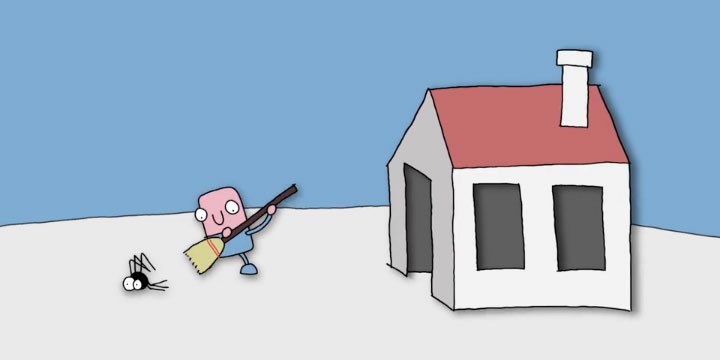
The Visitors © Philip Watts
TitleThe Visitors
ThemeAnimals, Intruders
Genre & keywordsComic, spider, house, broom, intruder
Age (for the film)3-11 years
Duration01 min 00 s
DirectorPhilip Watts
ProductionPhilip Watts (Australia, 2014)
Recount one of your phobias, then translate it into sculpture.
In The Visitors, does the character scream out of fear of spiders, fear of dirt, disorder, or simply out of surprise? Fear of animals (including arachnophobia) is the most widespread phobia, but many other, more exotic, phobias have been identified. If we can reflect on the cultural patterns that support them, we cannot simply work on the phobia, because of its irrational component. On the other hand, at the crossroads of the cultural and the psychological, there is artistic representation.
As in the film, where format conventions and habits of thought are lightly mocked, this activity invites you to play with the raw material of fears by manipulating their representation through a game of transcription. It is structured into three components, which can be practiced separately, but whose value lies in how they interlock: naming a fear (language / lexicality), telling a fear (language / narration), illustrating a fear (visual arts / 3D).
Name a fear. Each child chooses a fear that he has (in reality or fictitiously) experienced and creates a name for it, based on the model of medical nomenclature. The teacher can present the principle of this nomenclature (use of Latin, rules of concatenation) and study a list of phobias (see the Wikipedia page, or a specialized work) to have fun discovering names/concepts from the most common ("Arachnophobia", "Agoraphobia") to the most surprising ("Arachibutyrophobia: Fear of having peanut butter stuck to the palate", "Athazagoraphobia: Fear of forgetting or of being forgotten”, “Nanopabulophobia: Fear of garden gnomes with wheelbarrows”…). It is easy to see why it is interesting to imagine exotic fears, to be able to construct a new name – and vice versa: we could just as easily start from a random Latin compound to reconstruct its explanation.
Recount a fear. Based on a real memory, or alternatively a fear chosen arbitrarily by the child (for example created in the previous stage, or that of a friend), everyone writes a text recounting the circumstances and manifestations of this fear. All forms of narration are possible: a continuous first-person narrative, distanced description, fairy-tale conventions (“once upon a time”), a list in telegraphic style, etc. The only constraint will be one of length (between 10 and 40 lines for example) and content: talk about the place, talk about what caused the fear, talk about what happened before, during and after the moment of the fear (but without time or place limits). The teacher can take advantage of this to present different styles of narration (novel, diary, synopsis, poem, etc.).
Illustrate a fear. The aim is to give a three-dimensional representation of a fear, based on a story or a name. The sculpture/model can be the object of fear, an element of context or circumstance, a setting for the story, something evoked by fear, etc. Here again: no obligatory form, to encourage inventive transcription. Each child is free to compose a single sculpture or several objects, like in a diorama. However, you must preserve the illustrative link. So we will ask the children to prepare and explain, to tell their classmates about their production to explain this relationship.
The principle of transcription which underlies the activity lies in the sequence of the three components, the result of one being taken as a starting point for another. They can therefore be practiced in any order. We can take this structure as a creativity technique. For
examples of invention of phobia and more generally the principle of creativity exploited, see the drawings of Gary Larson cited on the Wikipedia page devoted to the list of phobias.
Activity sheet written by: Bruno Pellier