Educational activity based on the short film Wings and oars
Describe the states and constitution of matter on the macroscopic scale.
Observe and describe different types of movements.
Identify different energy sources and understand some energy conversions.
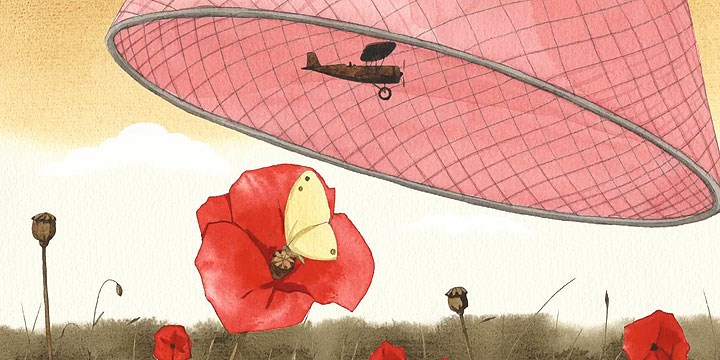
Wings and oars © Lunohod
TitleWings and oars
ThemeMemory
Genre & keywordsSurreal, childhood, memory, boat, plane, sea, river
Age (for the film)9-11 years old
Duration05 min 52 s
DirectorVladimir Leschiov
MusicP. Y. Drapeau & N. Roger
ProductionLunohod (Latvia, 2009)
Carry out experiments around devices using wind.
In Wings and Oars the wind is omnipresent. In every shot, without exception, it is made visible through the movement that it communicates to things: rippling grass, flowers and waves, a swinging bucket or laundry, cigarette smoke and floating clouds, swinging door or window, a ruffled lock of hair... It is an invisible, fragile yet constant force which, in the film, could symbolize change, the passage of time.
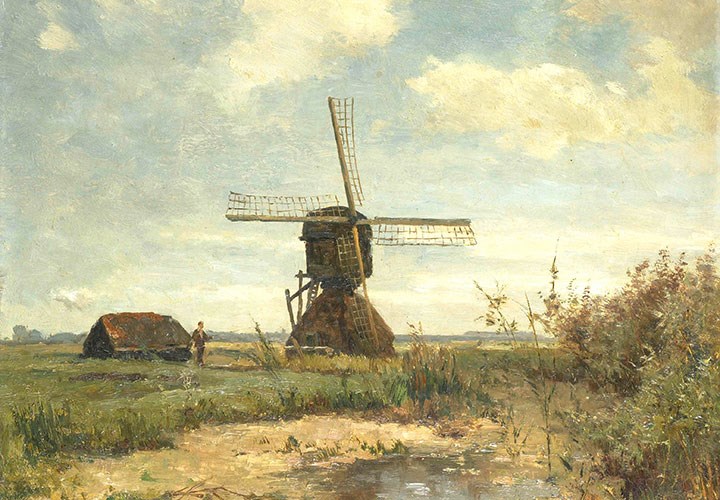
If wind, as a physical phenomenon, was only described from the 17th century with the experiments on atmospheric pressure by Torricelli and Pascal, devices using the force of the wind have existed since at least antiquity. It is the oldest source of natural mechanical energy identified by humankind. And at the same time, it is the stuff of myths and dreams.
In this activity, we will have the children experiment hands-on with a few principles of wind mechanics in relation to the imagination.
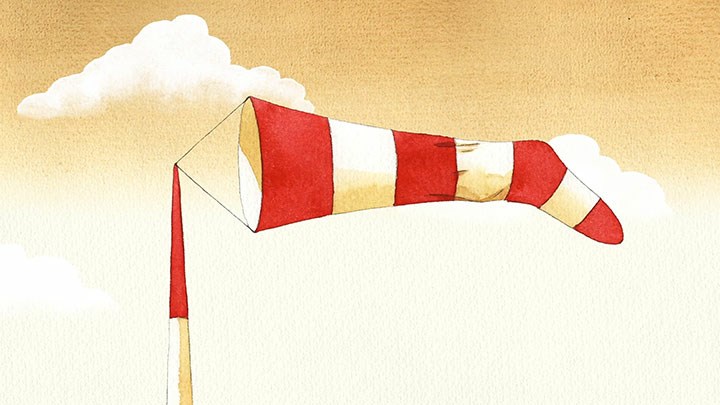
1- Air and wind We can start by returning to the scientific basics by formulating the definition of wind as movement in the earth's atmosphere. Depending on the knowledge already established for the class, it may even be necessary to remember that the air that surrounds us is a fluid, and that it therefore has weight and pressure. The examples of experiments on these notions, which are very easily found, revolve around the surprise of observing that something invisible like air can be surprisingly tangible. We can then return to the film and explain the devices found there to measure the characteristics of the wind: the windsock and the anemometer.
2- Sails and wings Through discussion and question sheets, we will focus on sails and kites: how the force of the wind can make them fly. We will draw a parallel with animal flight, focusing on distinguishing gliding and flapping flight, then attempts at human flight before aviation. The idea is to classify and put in order the properties linked to these flying objects.
3- The propeller The third step specifically addresses the principle of the propeller: by pushing against the fluid, the propeller's rotation produces forward (linear) motion (and vice versa). The experiments to be prepared should show the 4 scenarios combining energy transfer and movement: fixed motorized propeller moving the fluid (fan creating wind), passive fixed propeller set in motion by the moving fluid (windmill), motorized mobile propeller moving in the fluid at rest (drone), passive mobile propeller moved by the moving fluid (balloon helicopter). We can then consider the case of the flight of the lime-tree (linden) seed.
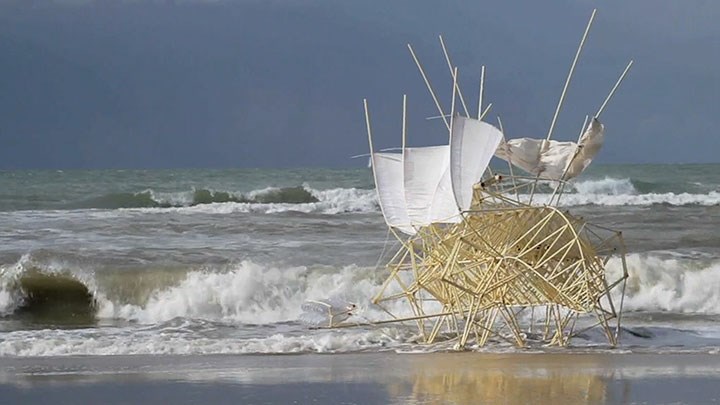
4- The beasts of the shore The last step consists of presenting the sculptures of Theo Jansen, showing how they make use of the concepts explained in the previous steps, while explaining his ambition to develop “autonomous creatures”. The majority of his work can be presented in the form of videos and images, a good part of which can be viewed on his site. As a practical exercise, the class can assemble and bring to life one of his small sculptures, kits of which are available on the web.
Activity sheet written by: Bruno Pellier