Educational activity based on the short film Wings and oars
Produce varied writing by taking ownership of the different aspects of writing.
Rewrite based on new instructions or develop your text.
Master the form of words in relation to syntax.
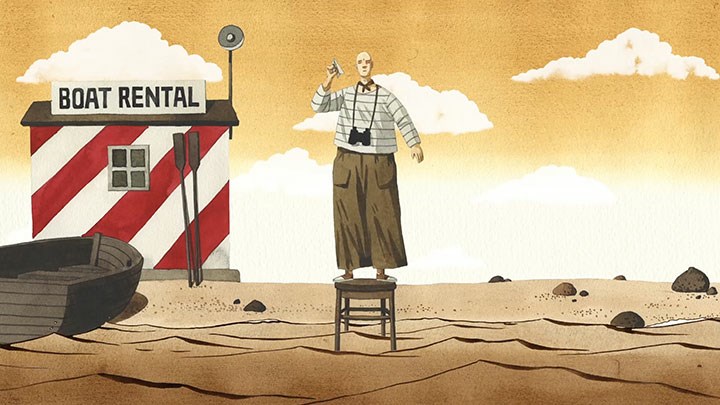
Wings and oars © Lunohod
TitleWings and oars
ThemeMemory
Genre & keywordsSurreal, childhood, memory, boat, plane, sea, river
Age (for the film)9-11 years old
Duration05 min 52 s
DirectorVladimir Leschiov
MusicP. Y. Drapeau & N. Roger
ProductionLunohod (Latvia, 2009)
Experiment with writing about one's past self.
In Wings and Oars, nostalgia arises from the comparison between the young man's life as an aviator, free and light, and his situation as a mature man, one of attachments and inertia. It seems to be the mark of the external and detached, somewhat sad look that we have on ourselves with age. But at the same time all the images of the character and those around him are similar. They echo, they wear the same ruts, as if the character were trapped in them, unable to escape from himself. This is the challenge of all self-writing: rehashing or reinvention.
In literature, this question arises particularly acutely for the genre of elegy. Traditionally poetry of lament, of the sorrows of love, of mourning, it explores from Latin origins the place of the “I” in the text. Closer to us, the poet Emmanuel Hocquard (1940-2019) renewed reflection on the meaning of this poetic genre by defending an elegy free of self-staging and the theater of pathos. This writing of the past is meditative and playful at the same time. It encourages you to multiply wordplay, to experiment with the limits of your own language. And, as he himself says (taking up the philosopher L. Wittgenstein), it is not necessary to wait until you are old to do this work, you must write “from your own height”.
In this activity, we propose a writing exercise allowing us to manipulate the elements of the elegy (memory, emotion, the self) to see how it produces a different experience of the sentence. And vice versa: how different forms of sentences lead to different experiences of emotion, memory and the self. The exercise does not start from a general study of the elegy, but from a text which presents a modern version and is today considered a classic. It is Je me souviens (I Remember), by Georges Perec (published in 1978). This text is exemplary with regard to the question we propose to explore, because it uses a very simple device in the first person without foregrounding the author's private life. It is a collective portrait, that of a generation.
The activity takes place in three successive phases of writing and reflection on the texts produced, after a quick presentation of the text by Georges Perec and the reading of extracts. “I remember” This involves children writing memories in the style of Perec’s text. Letting themselves be guided by their memory and their emotions, they choose around ten memories (good or bad, recent or old, precise or very vague) and put them on paper, starting with the same formula as in Perec's text. There are no other instructions (no order of memories, no length constraints, etc.) and it is important to tell them that these memories will not be shared with their classmates. On the other hand, they will be invited to “perfect” their text with the aim of having it published, in one copy, for them. The children choose how to interpret this word. They can ask for help to correct mistakes, they can decide to simplify or detail, make clearer, etc. At the end of this phase, they give the text to the teacher who will produce a clean and printed version, to give to them at the next session. It should be noted that children may very well choose to talk about an absence of memory (e.g. “I don’t remember the toys from my first Christmas”).
“You remember” In this second phase, and after discovering their personal “edited” version, the children return to their text and will have to transcribe it, this time using a slightly more constrained form. Out of the 10 memories, they choose 3 and write them as if they were writing a letter to
themselves. They should only use the pronoun “you” and begin each memory with “You remember” (or “You don’t remember”). At this stage, they can (and will probably have to) cut, change certain details, since each memory will this time have to fit into 60 words (approximately) for two sentences maximum and the texts will also be shown to the whole class. The teacher collects the texts and puts them in the form of a poster for each child, in preparation for the last session.
“I also remember” For the third phase, the teacher displays the texts and everyone comes to discover them. Writing now consists of choosing collectively, through discussion, around ten memories, then rewriting them one by one, always collectively, using the first person (“I remember”). Modifications can still be made to improve readability, but personal references (people events, etc.) are not explained. The memories are then ordered, according to all the criteria that the group deems necessary, to finish composing this collective poem, which will also be published and distributed to the children.
The meaning of this progression in three phases is to experience in a concrete way, through language, an increasingly greater detachment from the subjective involvement typical of this type of exercise. In the end, the emotion is there, but it is no longer self-indulgent or theatrical, exactly like in Georges Perec's text.
Activity sheet written by: Bruno Pellier