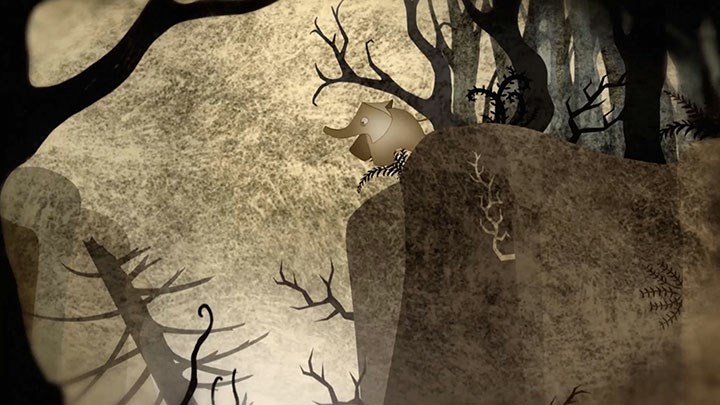
Educational activity based on the short film Ahco On The Road
Explore visual representation and modes of presentation: visual storytelling, juxtaposition, framing, taking into account the viewer and the desired effect
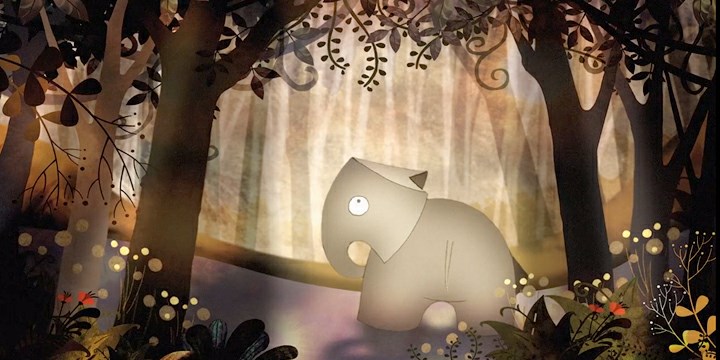
Ahco On The Road © Yellowshed
TitleAhco On The Road
ThemeAnimals, Family relationship, Maternal love
Genre & keywordsNarrative, Baby, elephant, forest, travel
Age (for the film)6-11 years old
Duration08 min 27 s
DirectorSoyeon Kim
MusicKaren Tanaka
ProductionYellowshed (United States, 2013)
Analysis of the cinematographic language of the film: expressive framing and focusing.
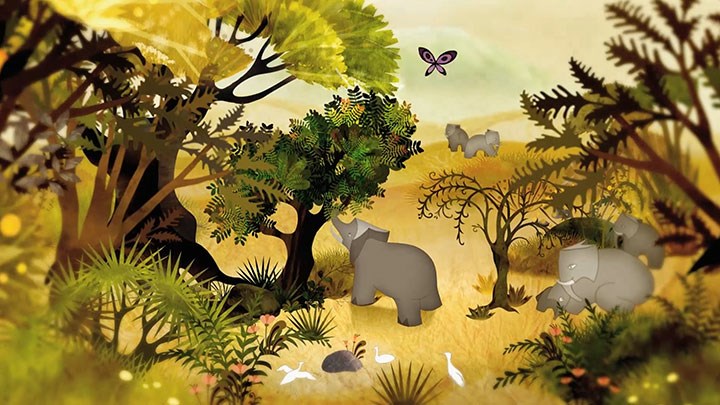
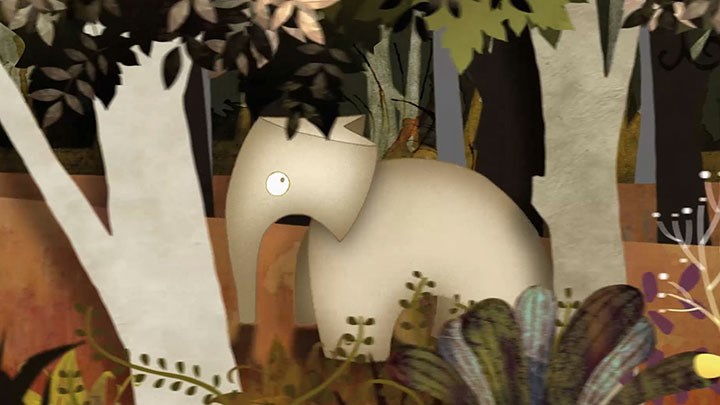
For an 8-minute animated film telling a very simple story, Ahco on the road employs a great many film techniques: expressive use of offscreen space, multiple shot scales, (virtual) camera movements, focusing effects, different types of edits (match cuts), etc. They are used to develop the theme of gaze, on two levels. At the story level, firstly, it is about showing how the character's view of the world around him widens around him. Hence the tracking shots that gradually reveal the setting and the play with offscreen space for the appearance of the animals he meets. On a more general level, the film talks about our view of animals, the way in which we project ourselves into their consciousness or, on the contrary, they remain mysterious to us. As a wildlife documentary would, Ahco on the road leaves the animals to their silence and the emotions it attributes to them are largely constructed by the codes of cinematographic expressiveness used: rhythms, music and the play of focalization across the shots.
We propose to study these constructions in the film, in particular the treatment of framing and camera movements.
1- State the purpose of the analysis
We can start the project with a simple question about interpretation. The film is wordless and the animals are not portrayed very expressively. So how do we understand the details of the action, the intentions of the characters? And how does the viewer’s emotion evolve? We will therefore focus on the tools which will allow on the one hand the understanding of the situations of the story told and on the other hand the creation of an emotion. As we seek to concentrate on the images, we can start with a new viewing without sound, with these ideas in mind.
2- Present cinema vocabulary
Before beginning the study of the film itself, it is useful to introduce the usual notions used to describe images. We will define the following:
3-Use the tools on selected sequences of the film
The exercise consists of asking the children to match the images from the film and the elements introduced previously, for certain chosen sequences. Each sequence is made up of a certain number of shots which must be described by reusing the vocabulary covered.
They can be asked to work in small groups of 2 or 3 on ready-made worksheet questionnaires with film stills illustrating the different shots, or to take part collectively in “breaking down” the shots, discussing the projected images. In this second case, they can themselves represent the plan in drawing (on blank questionnaires) to translate the plan scale.
When the vocabulary cannot be applied exactly or when they hesitate, children are invited to note this hesitation and the problem that arises there.
The suggested sequences are:
4- Discussion on the staging of the sequences
From the previous sheets, the children will compare their choices and discuss questions of staging, that is to say the choice of a certain technique in terms of understanding and expressiveness: how does this help to better understand what is happening? what emotion does this provoke? This stage takes place in the form of a collective discussion, led by the teacher.
At this point, it may be useful to remember that the vocabulary presented was originally designed to describe cinema: human characters, filmed with a real camera. There is therefore a priori a certain inadequacy with this film, a cartoon presenting animals. In particular, close shot scales are made to highlight emotions on the face, which finds a limit in our case. This is an opportunity to show that the forms and techniques of a medium like cinema produce codes which guide interpretation, codes which are widely exploited here.
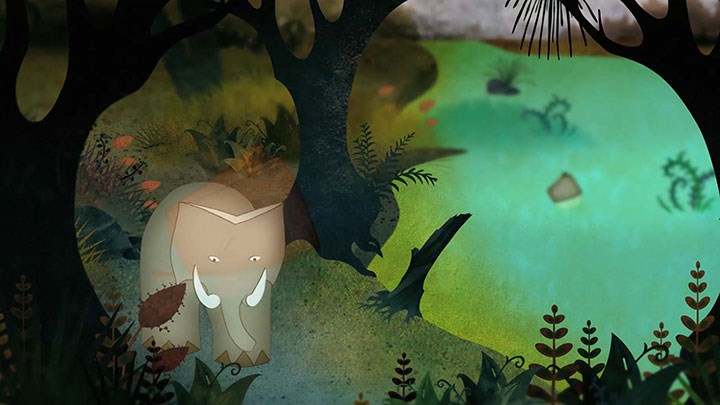
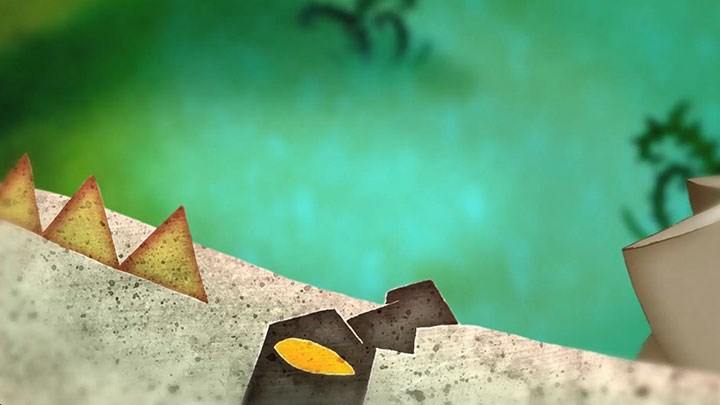
To discuss the expressiveness of the scenes, the way in which emotions are suggested in the characters and in the viewer, transmitted or in reaction to them, we can introduce an additional tool. We could ask ourselves what the focal position is in each shot. Whose gaze does the image represent? To simplify, we can distinguish two cases: the image can thus be framed as if it were seen by a witness external to the story (“external” focus), or on the contrary by one of the characters (“subjective” focus). This will help to better understand the shots where fear is suggested by frames which are as if seen by a character outside the frame whom we have not yet met spying on the baby elephant. This is the construction of an asymmetry of gaze, where the spectator is disadvantaged, just like the character. Someone is looking at the character, about to interact with him, but we don't yet know who it is.
5- Consolidating and extending learning
Finally, the children are invited to choose one of the sequences studied and to draw on their memory to cite examples of scenes whose staging seems similar to them. The examples cited can come from cinema (film, cartoon), television (music video, advertising), comics, or even literature. This work can be given to them to do at home, for a period of one week, for example. They will have to give the precise reference of the source and describe the scene in question, as well as the reasons why they perceived the analogy in the staging. As it can be complicated to be able to physically show the sequence, they will have to describe it precisely in writing, thus reusing the vocabulary introduced.
Activity sheet written by: Bruno Pellier