A very beautiful short film about maternal love in animals.
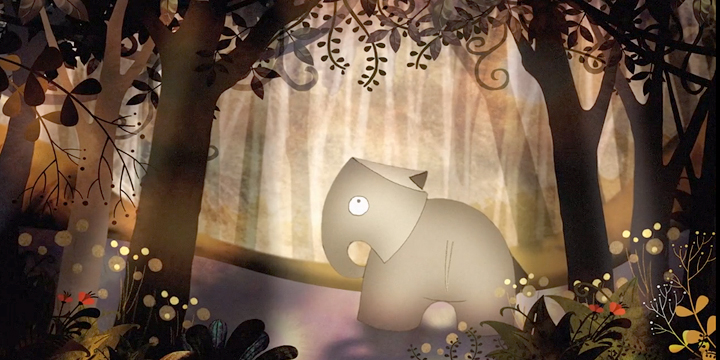
Follow the adventures of Ahco, a baby elephant lost in the forest and his happy or unfortunate encounters with other animals; the comfort of a ring-tailed lemur, the danger of crocodiles.
Children will perhaps project themselves into this touching character, desperate at having lost his mother.
The short film “Ahco On The Road” was selected for the Takorama 2023 festival organized by the Films pour enfants association.
1-What path does the baby elephant follow once it leaves the herd?
He goes at random, first following the butterfly, then in reaction (attraction, fear) towards the animals encountered, then he wanders looking for the way back.
2-What kind of meeting does he have? How does he react?
He meets other animals, each with different attitudes (friendly, indifferent, aggressive). He is surprised by everyone, proof of his inexperience as much as his curiosity.
3-What other stories does this one bring to mind?
Tom Thumb and similar tales, where children are lost and trying to find their home.
4-How do we understand the character's emotions?
By resemblance to what we would feel (or have felt) in the same situation.
5-What role does music play?
The music is expressive and follows the wonder, astonishment, worry or panic of the baby elephant.
6-Do we see the baby elephant in all the images in the film?
Almost on all of them.
And when we don't see him, it's because we see through his eyes. The film is entirely focused on this character.
7-Why are we afraid when the crocodile bites the baby elephant?
We imagine how we would feel.
We attribute the same feelings as us to the animal (anthropomorphism).
8-Do we know how the baby elephant would think in reality?
We don't know for sure how elephants think and feel.
Human emotions and thoughts are understood through language (verbal, bodily), which we have learned.
But elephants do not have this language. We can only try to imagine what they think and feel, by analogy.
Extensions and references
Cinema frame: analysis of the cinematic language of film — expressive framing and focusing.
For an 8-minute animated film telling a very simple story, Ahco on the road uses a large number of cinema techniques: expressive use of the off-frame, multiple shot scales, (virtual) camera movements, focusing effects, different types of connections, etc. They are used to develop the theme of gaze, on two levels. At the story level, firstly, it is about telling the broadening of the character's vision of the world around him. Hence the tracking shots which gradually discover the setting and the games with the off-frame for the appearance of the animals he meets. On a more general level, the film talks about our view of animals, the way in which we project ourselves into their consciousness or, on the contrary, they remain mysterious to us. As an animal documentary would do, Ahco on the road leaves the animals to their silence and the emotions it gives them are constructed largely by the codes of cinematographic expressiveness used: rhythms, music and games of focus of the shots.
We propose to study these constructions in the film, in particular the work of the frame and camera movements.
1- State the purpose of the analysis
We can start the project with a simple question about interpretation. The film is wordless and the animals are not portrayed very expressively. So how do we understand the details of the action, the intentions of the characters? And how does the viewer’s emotion evolve? We will therefore focus on the tools which will allow on the one hand the understanding of the situations of the story told and on the other hand the creation of an emotion.
As we seek to concentrate on the images, we can start with a new viewing without sound.
2- Present cinema vocabulary
Before beginning the study of film itself, it is useful to introduce the usual notions used to describe images. We will define this way:
- The frame, as a cut-out (choice) in what we want to show, as well as the out-of-frame, what is suggested but not shown in the frame. We can make analogies with painting, photography, drawing.
- The plan as a temporal unit of the film and as a “frame which persists over a certain duration” (we do not need to address questions of connection and editing).
- The different plan scales (general shot, long shot, medium shot, American shot, close-up, close-up, very close-up), each scale corresponding to a certain relationship between the setting and the characters, which plays on the understanding and expressiveness of what is shown.
- Camera positions and movements (traveling, panning, zooming, high/low angle) as a means of preserving or evolving a certain frame, of introducing a particular feeling.
- Some assembly figures used in the film: shot/reverse shot (alternation of two views from opposite directions allowing two points of view to be compared) and dissolve (mainly used here as an ellipse).
3- Use the tools on selected sequences of the film
Ask the children to match the images from the film and the elements introduced previously. Each sequence is made up of a certain number of shots which must be described by reusing the vocabulary covered.
The suggested sequences are:
- The character's introduction sequence (0'00'' - 0'35'' - 6 shots).
- The wandering in the jungle and the appearance of the lemur (1’40’’ – 2’25 – 12 shots).
- Awakening and the journey (4’03”-4’49 – 5 shots).
- The failed reunion (5’16-5’37 – 4 shots).
- The crocodile attack (5’34-6’38” – 20 shots).
- The flight forward until the cliff falls (6’39-7’04 – 12 shots).
4- Discussion on the staging of the sequences
The children will compare their choices and discuss questions of staging, that is to say the choice of a certain technique in terms of understanding and expressiveness: how does this help to better understand what is happening? what emotion does this provoke? This step takes place in the form of a collective discussion.
At this point, it may be useful to remember that the vocabulary presented was originally designed to describe cinema: human characters, filmed with a real camera. There is therefore a priori a certain inadequacy with this film, a cartoon presenting animals. In particular, close shot scales are made to highlight emotions on the face, which finds a limit in our case. This is an opportunity to show that the forms and techniques of a media like cinema produce codes that guide interpretation.
To discuss the expressiveness of the scenes, the way in which emotions are suggested in the characters and in the viewer, transmitted or in reaction to them, we can introduce an additional tool. We could ask ourselves what is the focal position on each plane. Whose gaze is the image? To simplify, we can distinguish two cases: the image can thus be framed as if it were seen by a witness external to the story (“external” focus), or on the contrary by one of the characters (“subjective” focus). This will help to better understand the shots where fear is suggested by frames which are as if seen by a character outside the frame whom we have not yet met spying on the baby elephant.
This is the construction of an asymmetry of gaze, where the spectator is disadvantaged, just like the character. Someone is looking at the character, about to interact with him, but we don't yet know who it is.
Educational activities offered by Bruno Pellier, Christophe and Olivier Defaye.
Created with the support of the French Ministry of Education and the French National Center for Cinema and Animated Images (CNC).
Watching the film with the family, educational activities with parents at home and with teachers in class.