Educational activity based on the short film Dark Dark Woods
Check your understanding and « behave like an independent reader ».
« Produce a variety of texts by taking ownership of the different aspects of writing. »
Literary and artistic culture: Heroes / heroines and characters.
Literary and artistic culture: « Imagine, express and celebrate the world. »
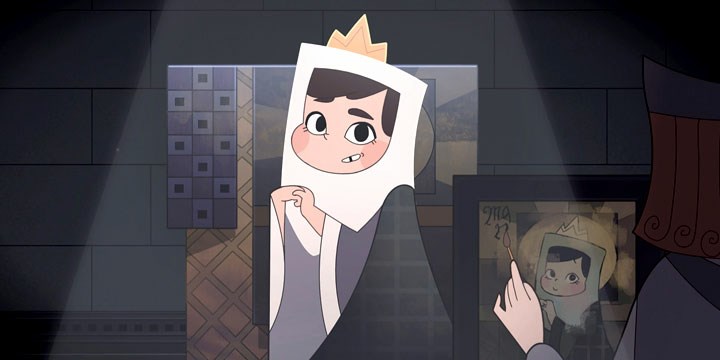
Dark Dark Woods © The Animation Workshop
TitleDark Dark Woods
ThemeFamily relationship, Princess
Genre & keywordsFantasy, parental relationship, king, queen, castle, dream, forest, animals
Age (for the film)9-11 years old
Duration07 min 44 s
DirectorEmile Gignoux
MusicK. H. Lampl & K. Lampl
ProductionThe Animation Workshop (Denmark, 2017)
Unravel the clichés of “princess stories” by creating a “literary puzzle”.
Dark Dark Woods involves a strategy to dismantle the stereotype of the princess: placing her in a context of “realistic” practices, in the social, historical and psychological sense. We are shown how the little girl must undergo painful training to resemble the image on the paintings in the portrait gallery. This “realism” is relative, but « the effect is still to demystify the image by humanising it ». (This is the same process that governs a film like The King's Speech, by Tom Hooper, 2010.)
Another strategy consists of staying at the level of the images, « heightening, so to speak, the usual ways they combine », cutting them up and reassembling them in a forced manner. Thus, what appears is « their artificiality, their ability to enter into endless games », their autonomy in relation to the “values” to which they are linked. A book like L’art poétic’, by Olivier Cadiot (P.O.L., 1988) is exactly based on this strategy. The book is entirely composed from extracts of literary quotations and example sentences taken from grammar textbooks or from the classics studied at school. To do this, he uses the cut-up technique. (See what he says in an online interview, in the magazine din.)
This activity aims to apply this same idea, in a more modest way, to stories about princes and princesses. We can offer children this task as putting together a large puzzle of an image of a prince/princess.
The first task is to gather the “stock” of passages that will be manipulated. It involves isolating fragments of texts taken from stories of princes and princesses, whether they are descriptions or actions « in which these characters appear ». This task can be entrusted to children, over a fairly long period, in the form of a “collection” activity. The passages in question should be written, but there is no requirement that they be taken from novels. They can be taken from comics, dictionaries, magazines, etc., as long as they are stories about princes and princesses. The passages should be collected in the form of clearly legible photocopies. « The teacher can suggest titles they know to expand the corpus » (medieval novels, classical plays).
The stock of passages is then pooled. Ideally, at least a hundred passages would be necessary. These are prepared, that is to say redivided into meaningful sentences, that is to say entire sentences or complete logical segments. It is these “sentences” that will be combined. The teacher is responsible for photocopying the stock made up of as many copies as there are students (or pairs, the assembly can be done in pairs).
The children are given a set of sentences and they are responsible for recombining them by pasting them on a large sheet of paper to form a new text, in the form they want: continued passage, verse, graphic mosaic, etc. Excerpts from L’art poétic’ can be shown to them as examples (chapters “an extraordinary adventure, an extraordinary adventure”, “n – 1”, “the lady of the lake”). We see, among other things, that the repetitions are interesting, that the ways of arranging the fragments have consequences on the way of reading, that we can group thematically or « recreate a sense of continuity in the story ». We will emphasize the fact that multiple avenues are possible, including an absurd reading or plays on the visual component of the text.
The children then share their creations by displaying them. This sharing can be followed by a discussion on their objectives and the effects produced. « Which pieces of work do they find fun, and which seem dull to them? » « Why? » What did they learn about telling the stories of princes and princesses?
Note: in the above we considered that we attached ourselves to the image of princes and princesses in an undifferentiated manner (« so as not to pick on the princesses, who don't deserve it »!). It may be more relevant to distribute these roles, to have the boys work on the princes and the girls on the princesses, or vice versa. This is up to the teacher’s convenience, but « blurring the gender roles can also be interesting » (revealing).
Activity sheet written by: Bruno Pellier