The film tells a simple story experienced by all children: how to invent an imaginary world to escape from a daily life hemmed in by the rules imposed by parents (and the whole of society behind them). The medieval setting adds a historical touch which sets out, in the first part of the film, to chip away at the idyllic image of the princess.
The film plays on the (rather facile) opposition between nature and culture. The world dreamed of by the little princess is in fact that of the threatening forest, populated by creatures that are frightening at first glance, whose plant life takes over everything, from the walls of the castle to the objects of the culture they want to make her conform to. The graphics support this opposition between the geometric rigidity of the castle and the invasive fluidity of the animals and plants of the forest.
The story is therefore that of the discovery by the princess of the value of transgression. But the experience is at best a small prick, with the character returning to the family circle to share her discovery for a moment. In the process, we will have mischievously navigated through a world of clichéd images and glimpsed the possibility of their flip side.
Understand the story, the theme, express your sensitivity and exercise your critical thinking.
The interest of Dark Dark Woods lies less in the story than in the reflections that it allows us to outline about the iconic value of images (images taken as a summary of cultural representations).
We can start discussing the notion of stereotype and identify all those used in the film in connection with “princess stories”.
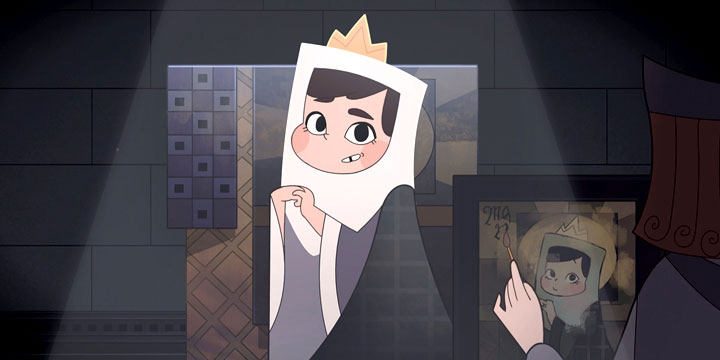
Next, it would be interesting to think about the effects of the images, as described in the part of the film where the little girl is taught to resemble the portraits in the picture gallery. We can extend this discussion by questioning the history of the place of women in society and in particular the differences between the image of women conveyed by courtly literature (which largely persists in contemporary representations) and the social realities of the classical Middle Ages.
Another area of discussion concerns the image of the forest. How does it oppose the usual life of the little princess and why? Is the forest still today the place of the unknown? The place of the forest, as a place of the wild and a place of life, also deserves a historical perspective.
1-Why does the little girl agree to do all the activities that are imposed on her?
A child is supposed to do what adults ask of him... A princess has duties regarding her rank, she must behave in a certain way, which she must learn...
2-Why is she afraid of forest creatures?
They are monsters: unknown creatures that live outside of humans. They come from the forest, which itself is a dangerous place.
3-Why can we say that the world of the forest is the opposite of that of the castle?
The forest is organic, wild, disordered, free, while the castle is mineral, partitioned, regulated, constrained...
4-What are all the elements that show that we are in a “princess story”?
The castle, medieval costumes, paintings, servants, conventional activities (maintenance, embroidery, music, literature)...
5-What new does the film show about princesses?
Their life was difficult, there were lots of rules to learn. They were not necessarily happy with their constrained situation. They were like prisoners...
6-In the castle, what are the portraits used for? Do they have an influence on the princess's life?
They are the princess's ancestors. They are the image of what it must become, of the models it must reproduce.
7-Why does the princess have so much fun with the forest creatures?
They make her experience what she cannot usually do. They are not subject to the rules of castle life, they break these rules. They take her out of the castle. They allow him to use his body freely.
8-What did the princess learn?
That life was not limited to the rules of being a princess, that her parents could also want to have fun, that the way we must behave in society is like a garment that hides what we really are...
References
On women's history: *History of women in the West - volume 2 The Middle Ages*, Georges Duby and Michelle Perrot, Christiane Klapisch-Zuber (dir.) (Plon, 1990).
On the history of man's relationship with the forest: *A story of the forest*, by Martine Chalvet (Seuil, 2011).
Created with the support of the French Ministry of Education and the French National Center for Cinema and Animated Images (CNC).
Watching the film with the family, educational activities with parents at home and with teachers in class.