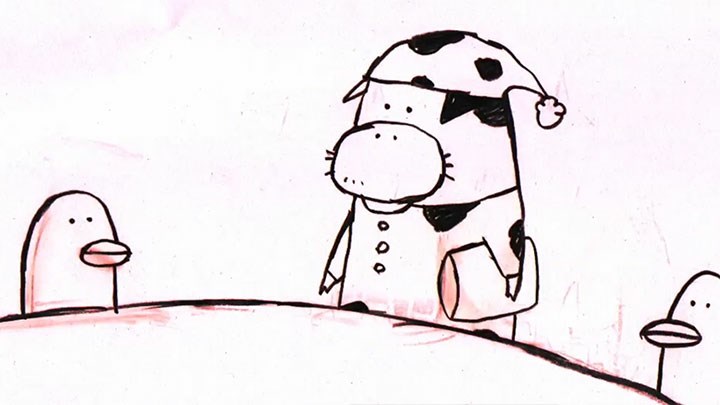
Educational activity based on the short film Ushi nichi
Identify from a work of art, through observation or listening, its main technical and formal characteristics.
Identify, in order to overcome them, certain cultural and artistic preconceptions and stereotypes.
Adapt your artistic project according to the constraints of production and consideration of the spectator.
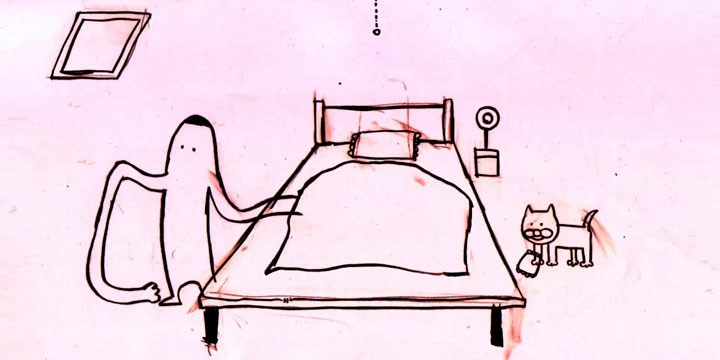
Ushi nichi © Decovocal
TitleUshi nichi
ThemeIrrational
Genre & keywordsAbsurd, animals, irrational, illogical, preposterous.
Age (for the film)9-11 years old
Duration09 min 09 s
DirectorHiroco Ichinose
MusicParallel
ProductionDecovocal (Japan, 2017)
Study the mechanisms of the absurd.
In its colloquial sense, the absurd (from the Latin absurdus, “discordant”) is from the outset that which is contrary to logic, to reason, to what common sense expects. This is the source of humor in this film as in many other productions, from the lightest to the most serious. This activity aims to explore part of this field of “absurd humor”, by associating it with other works and studying how it develops there.
Rather than starting from a precise definition of absurd humor (which would be risky, as there are so many definitions of humor), the approach will instead be a practical one: devoting ourselves to studying how the absurd, as a process, contributes to the humorous effect. In this way, by using the terms of the definition of the absurd, we will seek to show how logic can turn against itself, how reason can be outwitted, how to escape from common sense.
The work consists of presenting the chosen works and discussing them to compare them, identify what brings them together and bring out the mechanisms of the absurd. The comparative approach, when applied to productions from different fields, deserves a little assistance but opens up interesting perspectives for the field of art history.
The selection aims to link productions that cover a very broad field, from classic works to the most recent, from popular culture to so-called “learned” culture. They have been grouped in such a way as to identify several “study avenues”, which can be addressed on an ad hoc basis or combined into a long-term progression. Each of the tracks is accompanied by a “workshop”, a session of hands-on creative work where children can apply the concepts discussed.
The study of works should, as always, be contextualized (author, period, movement, technique, etc.). Furthermore, when it comes to researching the effects of the absurd, it is important to question questions of genre and convention with children. For example, it is absurd, in reality, to observe an animal talking, but in the context of the “children's story” genre, it is an accepted convention which generally no longer causes an absurd effect.
1- THE PARADOX Meeting of two contradictory or unrelated ideas, in a condensed formulation aiming above all for the humour of surprise.
Workshop: drawn variation of the surrealist exercise of the “exquisite corpse” (in pairs, each works on half of the sheet, the first extends certain lines of his drawing beyond the separation mark and folds the sheet to hide his drawing, the second must start again from the protruding lines).
2- THE MARVELLOUS The absurd elements follow one another to construct a world without referents, which seeks to preserve the primary wonder at things.
Workshop: Describe in several drawings a journey imagined from the following scenario: “At breakfast, your bowl of cereal sucks you in and you are projected into an incredible world. Describe what you discover there and your return. »
3- INVERSION, THE WORLD UPSIDE DOWN Here the absurd is developed and draws heavily on the social order, with a satirical aim.
Workshop: write a short story describing a day at school “in reverse”.
4- NONSENSE When the absurd works to undermine logic, without a complex ulterior motive.
Workshop: Cut-up proverbs. From a set of proverbs (or poems or very short fables) that we have printed on large sheets of paper, we cut them into fragments corresponding to grammatical entities, then we mix these fragments and recompose them freely to obtain absurd findings.
5. BURLESQUE The absurd mechanics here aims at discordance (trivial/elevated, simple/complex) and exaggeration, distortion. - Literature (novel): Rabelais, Gargantua (1534).
Workshop: Using image editing software to disguise/distort a famous painting.
Documents and references
Activity sheet written by: Bruno Pellier