Absurd humor.
In its familiar sense, the absurd (from the Latin absurdus, “discordant”) is from the outset that which is contrary to logic, to reason, to what common sense expects.
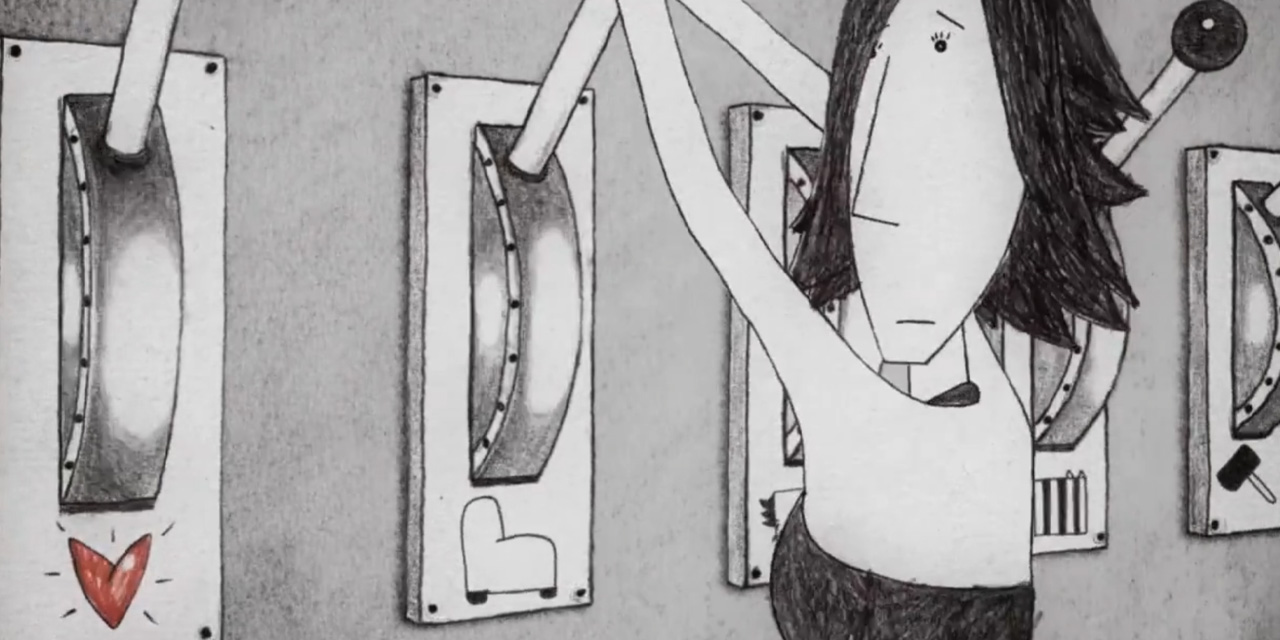
This manipulation has the effect of teleporting a chair. An armchair then appears in Yulia's space and, at the same time, it disappears from another space.
They are a couple, the stereotype of a traditional couple: the wife does the dishes while her husband watches television. The angry man shouts and appears violent. He blames his wife for the disappearance of the chair without any reason.
The woman seems tired and used to her husband's anger. She is also afraid of him and cries at his anger.
Yulia does not give in and shouts even louder than the man.
She becomes cheerful again and arranges the house in her own way. She breaks the television which was apparently an important object for her husband and replaces it with flowers.
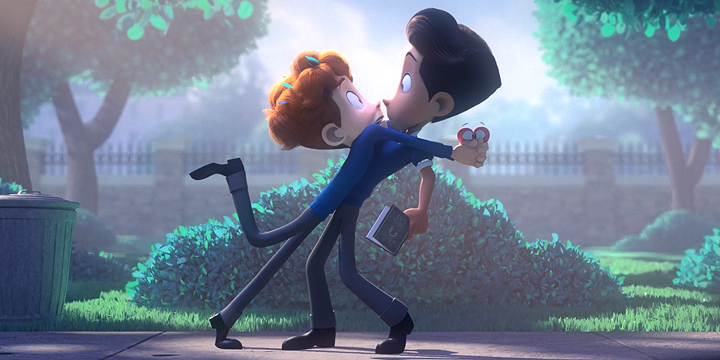
They fall in love. We understand this with the red color of their cheeks, the only color (along with the red heart of the first controller) in the black and white film.
The wife regains her freedom, changes her hairstyle, which is also a symbol of male domination.
Open response/debate.
We can discuss the notion of stereotypes but also conformism, what it means and how it is expressed in the film. This opens up many questions. What is the social influence on our behavior? Why respect social norms? Not to be noticed? Not to be sidelined? Integrate more easily into a group? Does being different and breaking free from the constraints of our society harm others?
2- How the absurd, as a process, contributes to the humorous effect
The work consists of presenting the chosen works and comparing them, identifying what brings them together and, thus, bringing out the mechanisms of the absurd. The comparative approach, when applied to productions from different fields, deserves a little assistance but opens up interesting perspectives for the field of art history.
The selection aims to link productions that cover a very broad field, from classic works to the most recent, from popular culture to so-called “learned” culture. They have been grouped in such a way as to identify several “study avenues”, which can be addressed on an ad hoc basis or articulated into a long-term course. Each of the tracks is accompanied by a “workshop”, a time for creative manipulation where children can exploit the concepts discussed.
The study of works should, as always, be contextualized (author, period, movement, technique, etc.). Furthermore, when it comes to looking for the effects of the absurd, it is important to question questions of gender and convention with children. For example, it is absurd, in reality, to observe an animal talking, but in the context of the “children's story” genre, it is an accepted convention which generally no longer causes an absurd effect.
- 1- The paradox
Meeting of two contradictory or unrelated ideas, in a condensed formulation where it is above all the humor of surprise that is aimed at.
Literature: extracts from Alphonse Allais, “Thoughts, texts and anecdotes” (Le recherche midi, 2000) or from Eric Satie, “The reasonings of a stubborn man, followed by Memoirs of an amnesiac” (Voix d’encre, 2013).
Sculpture: Salvador Dalí, “The Aphrodisiac Telephone” (1938).
Graphic arts: Jacques Carelman, “Catalogue of untraceable objects” (1969).
Workshop: drawn variation of the surrealist exercise of the “exquisite corpse” (in pairs, each works on half of the sheet, the first extends certain lines of his drawing beyond the separation mark and folds the sheet to hide his drawing, the second must start again from the protruding lines).
- 2- The marvelous
Absurd elements follow one another to construct a world without referents, which seeks to preserve the primary sense of wonder at things.
Literature (poetic story): Henri Michaux, “Ailleurs, Voyage en grande Garabagne” (1948).
Painting: Salvador Dalí, “Persistence of Memory” (1931), René Magritte, “The Land of Miracles” (1964).
Cinema: Victor Fleming, “The Wizard of Oz” (1939) or Jean Cocteau, “Beauty and the Beast” (1946).
Workshop: describe in several drawings a journey imagined from the following scenario: “At breakfast, your bowl of cereal sucks you in and you are thrown into an incredible world. Describe what you discover there and your return. »
- 3- Inversion, the world upside down
Here the absurd is developed and makes very strong reference to the social framework, with a satirical aim.
Graphic arts: anonymous, “The reversed world” (18th century engraving), Mucem collection, visible on the History in Images website.
Literature (novel): Lewis Carroll, “Alice in Wonderland”, chapter VII, “Tea Among Fools” (1865).
Graphic arts: selection of drawings by Gary Larson, volumes I to V (Dupuis, 1997-2002).
Workshop: write a short story describing a day at school “in reverse”.
- 4- Nonsense
When the absurd works to undermine logic, without a complex ulterior motive.
Cinema: A. Astier, A. Kappauf, J.-Y. Robin, “Kaamelott”, episodes to choose from season 1 or 2 (2005).
Visual arts: Roman Signer, video performances “Action kurhaus” (1992), “Kayak” (2000), “Punkt” (2006), “Old Shatterband” (2007), “Zwei schirme” (2009), visible online in a report from the Arte Tracks program (January 2015).
Literature (poetry, performance): Christophe Tarkos, “Je inflate” and “Tambour et tombola” (1998), in “The recorded” (P.O.L. 2014), also available online.
Workshop: cut-up proverbs. From a set of proverbs (or poems or very short fables) that have been printed on large sheets of paper. We cut them into fragments corresponding to grammatical entities, then we mix these fragments and recompose them freely to obtain absurd findings.
- 5- Burlesque
Absurd mechanics here aims at discordance (trivial/high, simple/complex) and exaggeration, distortion.
Literature (novel): Rabelais, “Gargantua” (1534).
Cinema: Laurel & Hardy, “The Battle of the Century” (1927), Buster Keaton, “Fridge Mover” (1922), “The Dismountable House” (1920).
Visual arts: Saverio Lucariello, “Vanitas” series (from 1995).
Workshop: use image editing software to disguise/distort a famous painting.
Educational activities proposed by Bruno Pellier.